How did I get here?
That question usually does not show up when life feels under control.
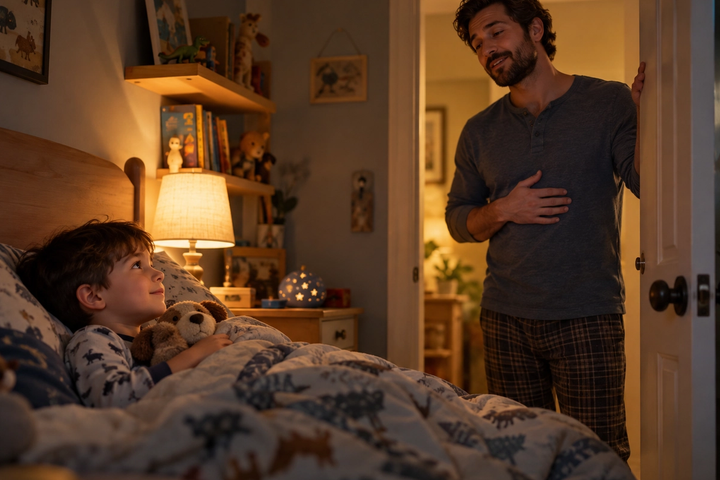
It tends to arrive later. When the house finally gets quiet. When the day is technically over, but your brain is still running a night shift no one approved.
You replay something small.
- A response that came out sharper than you meant
- A look from your child that makes you think, for half a second, maybe I missed something
- A moment that passes quickly, but somehow stays with you longer than it should, leaving that bitter taste of “I could have handled that better”
And somewhere inside that quiet second-guessing, the question appears:
How did I get here?
Not in a dramatic way. More like a low, persistent hum.
It did not start as something complicated
It started with something that seemed simple enough.
You had a child.
And with that came a kind of love that is hard to explain without sounding cliché, and yet there is no better word for it.
It changes your priorities before you have time to organize them. It makes ordinary things feel weightier. It makes you realize, very quickly, that what you do matters.
It matters to you. It matters to your child. It matters in the quiet, ongoing way that shapes another human being over time.
So naturally, you want to do it well. Not perfectly. Just well.
Then parenting begins, and you realize that “doing it well” is somehow expected to happen while you are tired, overstimulated, under-advised, over-advised, and occasionally eating cold food over the kitchen counter.
Then pressure joins the group chat
It rarely enters like panic, but more like a suggestion, such as a comment at daycare or something you read online at 11:47 p.m. that you absolutely did not need.
Or maybe a passing remark from some long-distance uncle who means well, or thinks he does, saying that you need to do this or that, that your child is a little behind, that most children are doing XYZ by now.
It sounds reasonable, and that is exactly why it sticks.
Once the idea gets in, it does not always leave. It sits quietly in the background, shaping how you look at your child and how you look at yourself.
I had that moment too.
We were told that our daughter was not crawling yet and that maybe it was something to check. No alarm bells. Just enough concern to give the thought a permanent seat in the room.
And it stayed.
Not in the same way for both of us. It stayed with my wife more heavily, and for longer.
Because that is what happens in parenting. A small uncertainty can become surprisingly heavy when it has time to repeat itself.
It is the kind of thing many people call parental intuition.
Then one day, during a parent-teacher meeting at daycare, I put our daughter on the floor and placed her favorite cookie a few meters away.
She crawled toward it immediately.
Nothing was wrong.
She simply had not found crawling worth the effort until there was a compelling enough reason. She had learned that if she raised her hands and cried, someone would carry her. The adults read that as “cannot crawl.”
Her interpretation was simpler: why crawl when premium transport is available?
That was it: a non-issue.
But the pressure leading up to that moment was real. And that matters too.
Because even when the concern turns out to be nothing, the emotional load it creates is still something.
Then you start seeing the pattern everywhere
Not only in milestones, but in absolutely everything.
Parents wondering if they are too strict or not strict enough.
Parents trying to follow a method that clearly does not fit their child, but sticking with it because trusting a script can feel safer than trusting themselves.
Parents avoiding clear action because they are afraid of what the answer might confirm.
Parents trying to stay calm while feeling very much not calm.
And then there is one of the quietest patterns of all:
Parents looking around before they act.
Looking at other parents, at strangers, at the invisible audience in their heads, as if someone else surely knows better, or thinks they know better, or might judge the decision, either silently or with surprising confidence for someone who is not raising your child.
It can start to feel like there is always one correct move, and parenting becomes a daily exercise in trying not to miss it.
That is exhausting.
We are not lacking advice. We are lacking orientation
There has never been more parenting information available than there is now.
You can find a method, an expert, a framework, a checklist, a chart, a ten-part thread, and three contradictory opinions in less than five minutes.
And yet many parents feel less certain, not more.
Because the deeper problem is not information. It is orientation.
Too many voices are telling parents what should matter, and not enough are helping them think clearly about what actually does matter in their home, with their child, in real life.
In many ways, this generation of parents is deeply thoughtful.
We reflect more, question more, and are more aware of emotional dynamics, development, attachment, nervous systems, regulation, boundaries, and a hundred other things previous generations were often not encouraged to think about.
That awareness is not a flaw. But when awareness meets constant input, quiet comparison, and the fear of getting it wrong, it can turn into chronic self-doubt.
You start overthinking moments that used to feel simple.
A moment many parents know immediately
Your child is having a meltdown.
You are with them, or trying to be, and then you notice other people: another parent, someone staring, and someone pretending not to stare, which is somehow worse.
And something shifts.
You are no longer only responding to your child. You are also responding to being seen. Part of you stays present, and part of you starts evaluating yourself in real time:
“Am I handling this well? Do I look too passive? Too firm? Not firm enough? Is everyone assuming I have no idea what I am doing?”
The goal quietly changes, stopping being only about helping your child through a hard moment and starting to become, at least in part, about not being perceived as the parent who is getting it wrong.
And that shift is revealing because it says something important about modern parenting:
Many parents are not only carrying the work of parenting. They are also carrying the performance of parenting.
Why Parents4Parents exists
That tension is part of why Parents4Parents came to be.
Not because parents need more pressure or because they need another voice telling them the right formula.
And definitely not because they need to be reminded that parenting is important, as if the 4 a.m. worry spiral had not already covered that.
Parents4Parents exists because many parents are doing one of the hardest jobs of their lives while feeling overstimulated, overexposed, under-supported, and quietly unsure whether they are allowed to trust themselves.
We wanted to create a different kind of space.
- A space that takes parents seriously
- A space that respects the emotional weight of parenting without turning everything into alarm
- A space that helps people think, reflect, and find steadier ground
Not perfect ground. Steadier ground.
The goal is not to become a flawless parent. It is to feel more oriented, more aware, and less alone inside the complexity of raising a child.
Sometimes that starts with practical tools, or with language for something you have felt for a long time but never quite named. Or even with the relief of realizing that the hard part is not always the moment itself, but the invisible load you carry while trying to handle it.
That is real, and it deserves attention.
So if you have ever found yourself asking, “How did I get here?”
Maybe the better follow-up is this:
What would help me feel a little more grounded from here?
That is the conversation we care about. And that is the one we want to keep building.