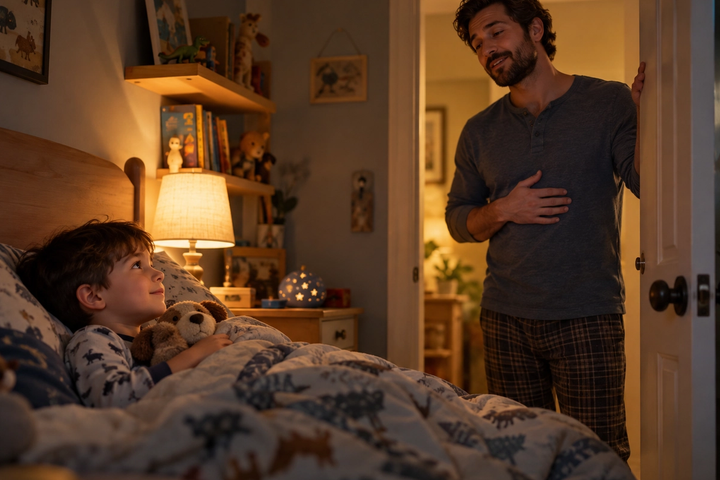
Picture an exhausted dad standing in a dark room with the kind of resigned determination of someone who has already accepted the night shift.
Sleep music is playing in the background, with highly debatable effectiveness. The stroller moves slowly back and forth.
My son had a fever. A cold. A blocked nose. He was clingy. Uncomfortable.
A tiny little angel who seemed personally offended by his own existence in that moment.
Up to that point, every attempt at a silent escape and every interruption in the movement had ended in ear-splitting protest.
In my head, I called my son “my boy.” And, as happens with desperate and exhausted minds, one thought pulled another.
Before we had children, we also used to call our Labrador “the boy.” After my son was born, that nickname became “the dirty boy,” which tells you quite a lot about what life with a dog usually looks like.
I still catch myself saying it to the dog sometimes: “You’ll always be my first boy.”
Not my best boy — that title belongs to Leo now — but my first.
And there, with my son drifting in and out of sleep in short waves in my arms, I felt something very clearly:
The depth of my love for Maui is not just affection. It is voluntary and conscious responsibility.
I have always loved dogs.
That part is not new, but the intensity of what I feel for Maui goes beyond that.
And I think I know why.
When he came to us as a puppy, I was very explicit with myself — and out loud too — about what was happening.
I was not just getting a dog.
I was taking responsibility for a life.
Not an abstract kind of responsibility. Not something like, “I’ll do my best and see how it goes.” It was a conscious decision:
“This life is now under my care and my protection. It depends completely on me.
I choose this.”
I remember feeling that strongly at the time. Almost like something solemn.
And I think that is why my bond with Maui feels so solid and so protective.
Because I named it. I chose it.
When you do that, something changes inside you.
Love can be instinctive.
It is an emotion. It comes from within.
Responsibility that is structured and clearly defined is not an emotion. It is a noble weight that has to be chosen. Responsibility becomes real when it is named.
When you say — even if only to yourself — this life is now tied to mine, three things happen:
- Responsibility crystallizes — it stops being vague care. It becomes guiding, teaching, and protecting.
- Identity takes shape, and you are no longer just someone who feels love: you are the person responsible for another life. You become protector, guide, provider.
That obligation does not disappear when it becomes inconvenient or exhausting.
With Maui, I crossed that threshold consciously.
With my son, something similar happened — but this time, with the support of a ritual.
I am not especially sentimental about ceremonies…
… Just for the sake of ceremonies. I almost never go to church unless someone drags me there. Which is exactly what my Italian wife did after our son was born.
But baptizing my son moved me more than I expected.
Not because of the water, the church, or the candles. It was because of the words. They went straight through me.
When I placed my hand on my son’s head, I made a few sacred promises.
Protection.
Guidance.
Responsibility.
Love.
Those words did not create something new — they made explicit something that was already true.
And by doing that, they steadied me inside the role I was already living. They sharpened my vision.
They turned instinct into an explicit promise of guidance and devotion.
They gave language to the scale of the responsibility.
And here is the part I think we do not talk about enough.
In modern society, becoming a parent happens far too fast — psychologically, faster than human beings seem built to absorb.
You do not need a course to conceive. Those who are lucky enough to conceive naturally simply follow animal instinct.
Nine months later, there is a hospital room, medical protocols, papers to sign, a baby in your arms.
And then they send you home. Still shaken by the almost primal intensity of what you have just lived through as a couple. Physically drained.
The nurse waves at you. Good luck.
Completely absorbed by the acute needs of that moment, you make a silent inner promise to keep that baby safe. It is all you can think about in that state.
I have never driven so slowly in my life.
Your front door opens. And your new life grabs you by the throat before you have a minute to think and process.
Sleepless nights.
Chaos.
Logistics.
Survival mode.
There is no real pause to mentally step into the role or a deliberate, conscious shift in mindset.
There is no moment where responsibility is clearly named and clearly accepted.
You are thrown immediately into high-stakes infant care. Your baby will never be more vulnerable than they are right now.
With family and friends knocking at the door to visit. Work and life demanding things. The dynamic between you as a couple radically changed. And zero sleep.
For thousands of years, meaning was not something people were expected to simply find on their own. It was collective, conscious, socially marked, and recognized. It was carved into your whole being. You were reborn as a new version of yourself. The moment of transition mattered.
It was not something you were supposed to understand in between diaper changes.
Just look at the marriage ceremony: who does not know those words? Do you take this person to be your lawful spouse? In sickness and in health? For better or worse? Till death do you part? It is almost impossible to escape how clear that is, is it not?
Can you immediately articulate what the equivalent words for parenting would be?
Neither can we.
Meaning usually arrives through language and ritual — and that layer has almost disappeared.
The result?
Parents carry enormous responsibility without ever fully claiming it. Not as something received, but as something taken on.
You are still responsible — but you never stopped long enough to say: I choose this. I accept both the weight and the privilege.
You have not clearly named or fully accepted the full scale of what parenting means to you. In that sense, you do not have a plan. You are always reacting, always one step behind.
Compare it to getting your dream job. The promotion arrives after an exhausting 12-hour shift. Effective immediately. But with no onboarding. No clear job description. No defined limits to the role. While you carry a crying newborn everywhere you go.
How would you rate your chances?
If you are not 100% clear on all the parts that make up your responsibilities, how can anyone expect you to do a complete and good job?
What we’re actually missing - and what we could rebuild
This isn’t about religion. It’s not about nostalgia.
It’s about role-marking. A moment where:
- responsibility is spoken,
- privilege and burden are named together,
- and a parent crosses a clear psychological threshold in their own mind.
This doesn’t make parenting easier. But it makes it clearer.
Because words don’t just describe commitment — they create psychological permanence and momentum. Once responsibility is spoken, it becomes part of who you are.And maybe that’s something worth recovering — for parents, for families, for ourselves.
Not another checklist. Not more advice. Simply a ritual to say, clearly and deliberately:
I choose to take responsibility for this life.