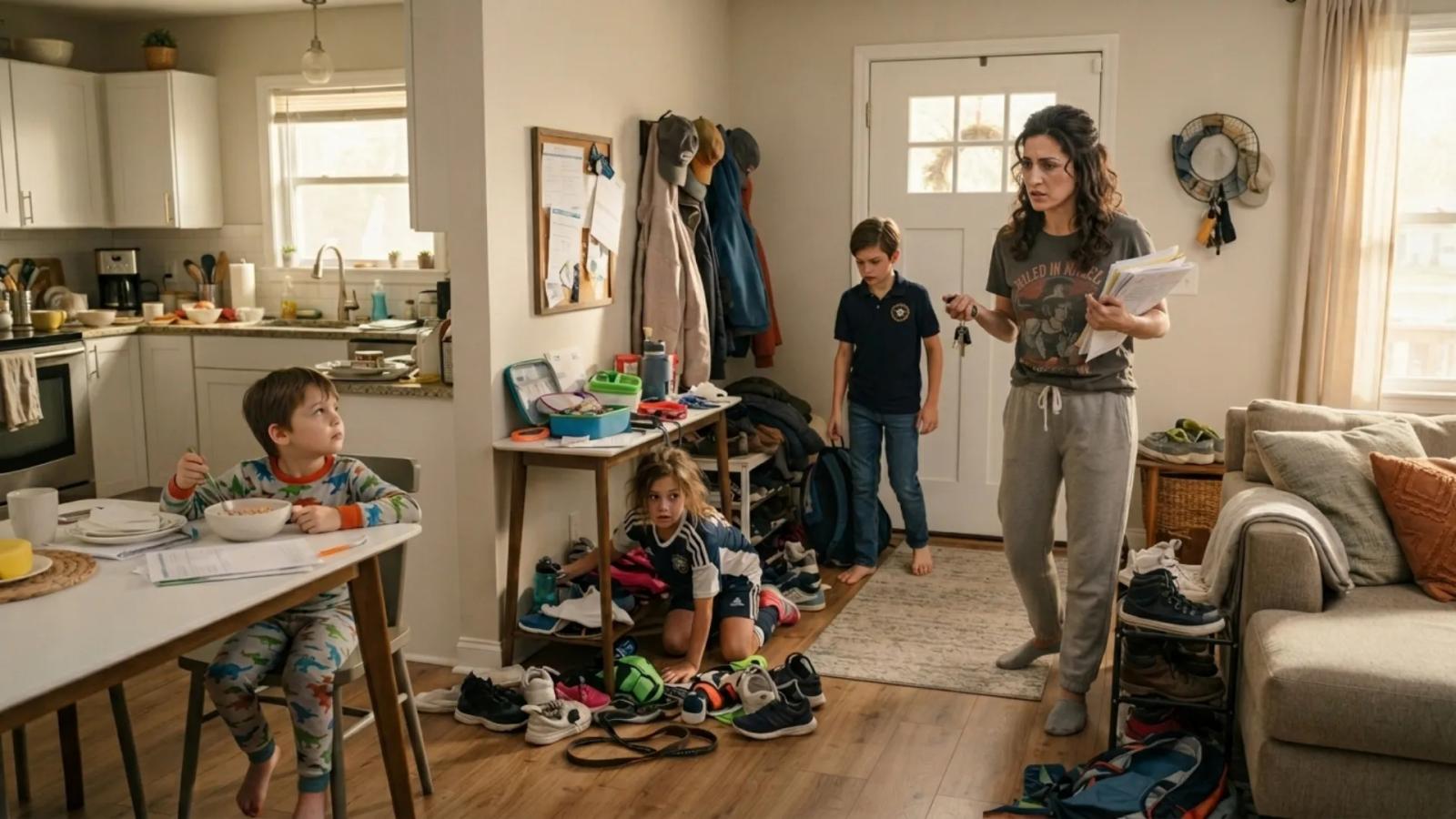
It’s 7:52am. You need to leave in eight minutes. One child hasn’t put on their shoes, another can’t find their water bottle, and someone is still in pajamas eating cereal at a pace that suggests they have absolutely nowhere to be.
You’ve asked three times. You’re now asking a fourth time, louder, with a tone you recognize from your own childhood and swore you’d never use.
You leave the house. Everyone gets there. But something was left behind at the door, and it wasn’t the water bottle.
Morning chaos is one of the most reliably frustrating parts of family life and one of the least talked-about in parenting content. Not because it’s unimportant, but because it’s so relentless it barely feels worth naming. It just… is.
The thing is, most morning chaos isn’t a parenting problem. It’s a structural problem. And structural problems respond to structural solutions, not to better intentions or louder voices.
(You’ve tried louder. It’s not the answer. You already knew that, which is probably why you’re reading this.)
Why mornings are structurally hard
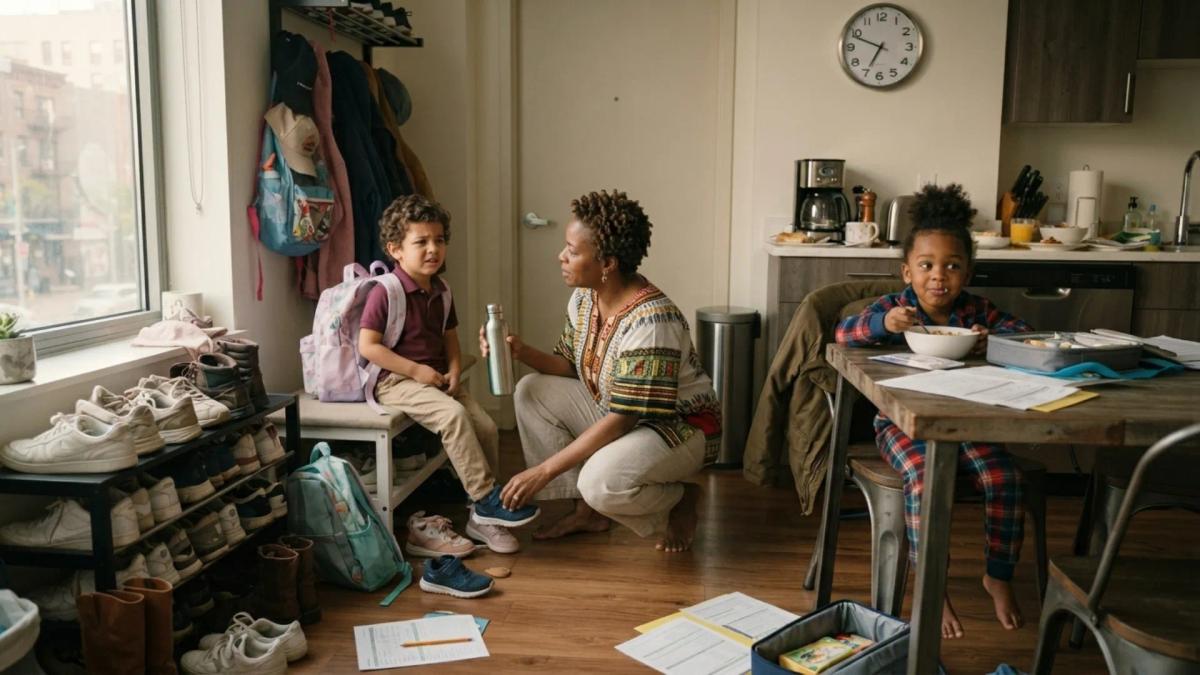
Morning is the worst possible time to ask human beings, especially small ones, to do a sequence of tasks under time pressure.
Kids’ brains take longer to wake up than adults’. The part of the brain in charge of planning and self-control is still coming online when they get up. Expecting a child to handle a long list of tasks at 7am just isn’t realistic, their brain isn’t ready for it yet.
Add to that the transition friction of moving from the comfort of home to the demands of school, the hunger and low blood sugar of early morning, the sensory load of getting dressed, and the time pressure that nobody actually chose but everyone is absorbing, and what you have is an environment designed to produce exactly the friction you’re experiencing.
So if mornings feel chaotic, it doesn’t mean your kids are difficult or your family is disorganized. It just means mornings are hard for everyone. The real question is what you can tweak to make things go smoother.
(Nothing about morning is designed for children. The schedules, the transitions, the expectations: all of it was built for adults and applied downward. Which explains a lot.)
What makes mornings worse than they need to be
Some factors consistently amplify morning friction beyond what’s structurally inevitable. Worth knowing them:
- Too many decisions left for the morning.
- Unclear sequences and expectations.
- Too little time was built into the plan.
- The adult’s nervous system is already activated.
- Transitions are happening too abruptly.
Leaving too many choices for the morning, like what to wear or eat, or where the backpack is, makes everything feel harder. When all those little decisions stack up before 8am, kids’ brains get overwhelmed and slow down. It might look like they’re just dawdling, but really they’re running out of steam.
Unclear sequences and expectations. "Get ready" is not a sequence. "Shoes, bag, coat, then you can wait by the door." Children who don’t have a clear picture of what done looks like will fill the gap with whatever their brain finds more interesting, which is almost never what you need them to do.
Too little time was built into the plan. Most families underestimate how long the morning actually takes, and then attribute the gap between the plan and reality to the children. Adding 10 to 15 minutes to the planned departure time eliminates a significant portion of the urgency that drives yelling.
The adult’s nervous system is already activated. When you wake up already in go-mode, already running the mental list of everything that needs to happen, your baseline tone is tighter than usual. Children read that activation and tend to respond to it by either mirroring it (escalating) or moving away from it (slowing down). Both make the morning harder.
Transitions are happening too abruptly. Pulling a child from sleep or screen directly into "shoes on now" skips the transition buffer their nervous system needs. Abrupt transitions produce resistance, and resistance produces delay, and delay produces the spiral that ends with everyone in the car in a bad mood.
(A lot of what seems like your child making mornings tough is actually just the morning itself making things tough for your child. That difference matters, one you can work on, the other just leads to blame.)
Adjustments that actually reduce friction

These aren’t tips for perfect mornings. They’re structural changes that make the bad ones less frequent and the average ones more manageable:
Move decisions to the night before
Pick out clothes, pack bags, decide on lunch, put shoes by the door, do whatever you can the night before. Make it a habit, not a chore, so it just becomes part of the routine. Kids have way less brainpower in the morning than they do at night, so set them up for an easier start.
Build a visible sequence, not a verbal reminder loop.
Try a checklist on the wall, a picture chart for little ones, or a whiteboard in the hallway, whatever fits your family. When kids can see what comes next, you don’t have to keep repeating yourself. That small change can totally shift the morning vibe.
Add buffer time and protect it.
Calculate how long the morning actually takes on a typical day, then add fifteen minutes and make that your new plan. Use that buffer not as more time to rush through the same things, but as breathing room. When you’re not already late before anything goes wrong, the small things that go wrong don’t cascade.
Give a transition warning before each step.
"In five minutes we’re turning off the TV and putting on our shoes." "Two more minutes and then breakfast is done." Warnings before transitions reduce the abruptness that triggers resistance. The nervous system needs a moment to shift gears, and a warning gives it that moment.
Anchor the morning with one calm thing.
Five minutes of something that isn’t rushing: breakfast together without checking phones, a short playlist that signals "morning mode," a specific ritual that happens the same way every day. One predictable, low-demand moment signals to everyone’s nervous system that the day is starting from a stable place, not a chaotic one.
Separate the connection from logistics.
Morning works better when the first few minutes aren’t immediately logistical. A brief, warm greeting before the list starts, eye contact before the instructions, a moment of actual human contact before the machine kicks in: this doesn’t cost time, it buys cooperation. A child who feels seen is more likely to move with you than against you.
(None of this requires a perfect family or a perfectly organized home. It requires about twenty minutes of setup the night before and the willingness to do it consistently enough that it becomes the default. The default is the thing that saves you at 7:52am.)
When it still falls apart
Even well-designed mornings fall apart sometimes. A child who didn’t sleep well, a forgotten library book, an emotional moment that can’t be rushed: some days the structure holds, and some days it doesn’t.
When it falls apart, a few things help more than others:
- Pick one thing to let go of. Not everything can be saved. Deciding quickly what matters most (usually: getting there, not how everyone feels about getting there) reduces the number of battles in the last five minutes.
- Lower your voice when you want to raise it. This is genuinely hard and genuinely effective. A quieter tone in a chaotic moment is disarming in a way that a louder one never is.
- Name what’s happening without blame. "We’re running late, and I’m stressed" lands differently than "Why do you always do this?" One describes the situation, the other describes the child. Only one of those leads anywhere useful.
- Repair afterward, briefly. If the morning ended badly, a short acknowledgment in the car or at drop-off ("that was a rough one, sorry I got snappy") costs nothing and matters a lot. It models that relationships can take a hit and come back.
(If you end up yelling but then make up, that’s not a parenting fail, it’s just a morning. The way you repair things is what really teaches your child something important.)
What mornings are also doing
There’s something worth naming about what the morning rush costs beyond the immediate chaos.
The last thing that happens before a child goes into their day sets the emotional tone they carry into it. A morning that ends in yelling, in tension, in someone feeling bad, sends a child through the school door already carrying something heavy. That doesn’t mean every morning has to be peaceful, but it does mean it’s worth trying, not for the sake of the routine, but for what your child takes with them when they leave.
And the first thing that happens when they come back should undo whatever the morning left, which is its own conversation. But it starts here, at the door, at 7:52, with eight minutes to go.
(You’re not just trying to get out of the house. You’re trying to send them into their day in one piece. That’s worth the extra fifteen minutes of buffer time.)
FAQs
My child moves slowly, no matter what I try. Is this just who they are?
Some children are genuinely slower processors and have a harder time with transitions and time pressure. That’s temperament, not defiance. For these kids, the solutions are the same, but the buffer needs to be larger, the warnings need to come earlier, and the expectations need to be adjusted. A slow-moving child in a fast-moving morning will always produce friction. The answer is usually to slow the morning down to meet the child, not to speed the child up to meet the morning.
What about the child who is fine until one specific step, then completely derails?
The specific step is usually the transition point with the most sensory or emotional load for that child: getting dressed (sensory), leaving the screen (transition), eating breakfast (hunger plus time pressure). Identifying the specific friction point and addressing it directly (different clothing options, earlier screen cutoff, earlier breakfast) tends to work better than trying to fix the whole morning at once.
I’ve tried checklists, and they stopped working after a week. What now?
Checklists work until they become invisible, which is usually about two weeks in. Refreshing the format (new chart, different location, let the child design it) tends to buy another stretch of engagement. The goal isn’t to find the perfect system; it’s to maintain enough novelty for the system to stay visible. Kids also do better with checklists they helped create than ones handed to them.
I’m not a morning person. How do I regulate myself when I’m already dysregulated?
One thing that helps: building your own transition ritual before theirs starts. Five minutes before the morning officially begins, when you’re not yet in parent mode, not yet managing anyone, just existing. Coffee, quiet, a window: whatever works. You can’t reliably co-regulate a dysregulated child from a dysregulated nervous system. The overhead mask goes on first.