In theory, everything works beautifully
You memorized what that TikTok profile told you to do when your child melts down in the grocery store, and you also saved your neighbor’s tip on how to get your child to sleep.
You can know exactly what you are supposed to do and still not be able to do it when the moment actually comes.
In the moment, getting down to your child’s level, validating the feeling, holding the boundary, and staying gentle somehow all disappear.
Do you know why?
Because you are late.
Relax, not late in life. Just late in your day, and your child cannot find their shoe, and you are holding a backpack, a water bottle, and your nervous system.
If that sounds familiar, keep reading, because this is about to feel even more familiar.
The problem is not that you forgot the advice
A lot of parents think the problem is that they cannot apply what they already know.
Most of the time, that is not it.
The problem is usually the context.
Advice is normally written for calm conditions.
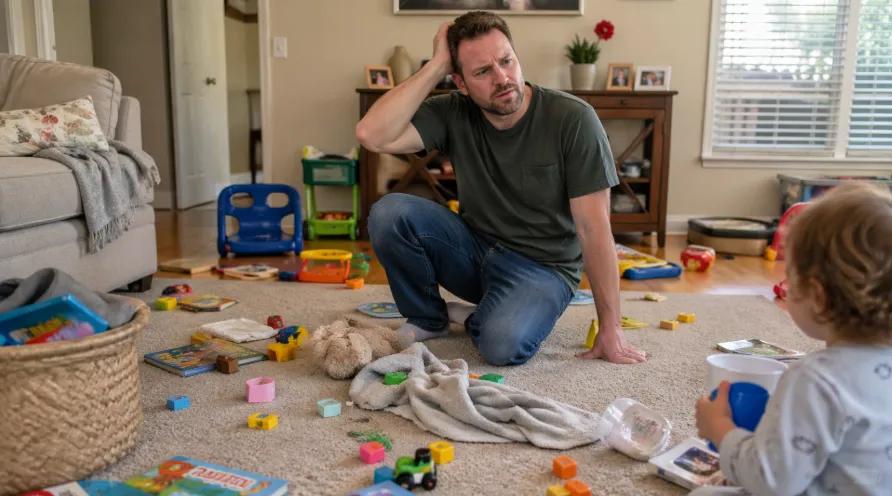
Parenting happens in moving conditions. Loud ones. Public ones. Late ones. Sleep-deprived ones. With someone asking you a question from the back seat while another small person is crying and licking the window at the same time.
So no, most parents are not struggling because they lack knowledge. They are trying to function well inside conditions that make even a decent response harder.
Good advice can fall apart for very normal reasons
“Stay calm” sounds great until your child throws themselves onto the grocery store floor at the exact moment you realize you forgot the one thing you actually came to buy.
“Be patient” is lovely until you have repeated the same sentence six times, nobody has shoes on, and the clock has now joined the argument.
“Turn every moment into a teaching opportunity” is excellent advice if everyone slept well, ate properly, and is open to hearing a lesson on emotional regulation while standing in a parking lot.
A lot of good advice is not wrong. It is just incomplete.
What it often leaves out is that the adult is also a person. A tired person.
A person in a rush. A person carrying sensory overload. A person with limits. A person whose inner weather is already starting to turn.
Parenting works better when it can adapt

That is why, in real life, parenting requires more adaptation than perfection.
Sometimes the ideal response is simply not available. Sometimes the best you can do is choose the least destructive version of the moment.
A shorter response. A less cutting tone. A boundary that did not come out beautifully, but still held. A repair afterward, when the scene did not go the way you wanted.
That still counts.
In fact, that has a lot more to do with real parenting than the polished version so many people think they are supposed to be reaching.
And that is what we believe: raising a child has much more to do with trying, adapting, and repairing than with getting everything perfect.
Done is always better than perfect.
Maybe you do not need more advice. Maybe you need more room to be human.
Did you know that you are also a human being?
A lot changes when parents stop treating every imperfect moment as proof that they are failing.
Sometimes the advice did not fail because you failed. It failed because the moment was messy, rushed, public, emotionally loaded, and completely uninterested in becoming a textbook example.
That does not mean parenting is falling apart. It just means it is alive.
And everything alive is usually a lot louder than advice makes it sound.
So if you can leave this post with one thing fixed in your mind, let it be this: try to adapt what feels best for your child within the conditions you actually have.
Done is better than perfect.