I never thought I would be doing real DIY with a toddler.
But the other day, I was putting together a bookshelf for my wife. Nothing special. A flat-pack box, a paper manual, a floor slowly disappearing under wooden panels, screws, tools, and all the little pieces that make you suspicious this whole thing will turn out wrong at the very end.
Naturally, this large new item and the shiny metal tools drew the immediate and undivided attention of my children.
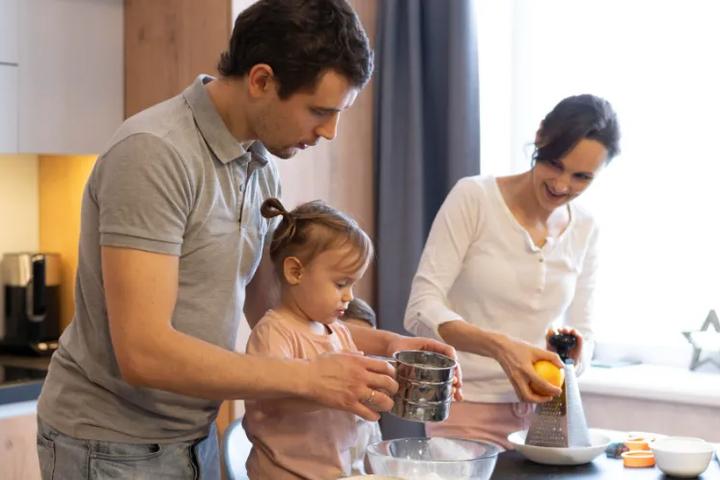
My three-year-old daughter insisted on helping.
Not in the usual I’m helping way that often means hiding important screws in an old pair of shoes. She meant it seriously. Fully. With the solemn commitment of someone who had just joined a major construction project.
She honestly wanted to know the names of the tools. Why this screw was different from that one. Why this step came before the next.
And I could not have been happier to teach her.
She handed me tools with reverence, like I was performing surgery. She dragged wooden parts across the floor, cheeks puffed from effort, barely able to lift them but absolutely determined to contribute.
She asked how the manual worked. Why I was doing this now, and that later. Why the panels had to face a certain way.
At one point, she held a piece steady so I could fix it in place. At another, she carefully placed screws into their holes by hand, ready for tightening with the screwdriver by daddy.
Later, she picked up the Phillips screwdriver and, with fierce concentration, turned a few screws I had turned halfway in, fully in by herself.
I was so genuinely proud of my 3 year old girl that I was beaming and clapping. I complimented her trying so hard and learning so fast.
She was glowing.
What we mean by a Formative Moment
At Parents4Parents, we sometimes talk about Formative Moments.
Not as grand milestones. Rather, they are the small, deceptively everyday moments that teach them something about themselves and their capabilities.
Small realizations like:
- I can help.
- I can learn.
- I am trusted.
- I belong here.
- I can do things that matter.
Those realizations do not usually arrive because we explain them well. They land through experience.
And they often happen when a child is organically trusted with something real. Not something manufactured to look educational. Not a fake job that everyone knows is fake. Something that actually belongs to family life.
Putting together furniture. Cooking dinner. Carrying groceries. Holding a door. Passing a tool.
Being useful in the same world adults are useful in.
The difference between praise and identity
As we worked, I kept naming what I saw.
How strong she was. How clever. How carefully she was watching. How much she was actually helping.
“Look at what you can do!”
There is something deeply satisfying for a child in being genuinely useful.
Not just entertained and kept busy with a pretend version of the task while the adults do the real work somewhere else.
Included.
That was the difference. She was not pretending to be big. She felt big. And because the contribution was real, the praise landed differently.
Empty praise can float past children. They may enjoy it, but it does not always settle. Recognition tied to real contribution has more weight because the child can feel the truth of it in their own body.
She knew she had really helped. She had carried something. Held something. Turned something. Asked questions. Stayed with the task.
And in that moment, I could almost hear a Formative Moment clicking into place.
I am someone who can help.
I can do difficult things.
I have a place in this family.
That is a big thing for a small child to feel.
Why these moments matter more than we think
She may not remember the bookshelf. I hope she will, but she may not. Childhood memory is strange that way. The specific may disappear from her mind completely.
But I think something of the experience will stay.
Not necessarily as an image. More as an understanding. The feeling of being trusted. The feeling of being useful. The feeling of standing beside an adult and doing real work together.
Building that shelf has allowed her understanding of herself to be changed. From pretend to useful. From unconfirmed ability to proven effectiveness. And it will change how she behaves in the future. Formative Moments often live like that. Evidence that shows they can do things. And over time, those little pieces stack.
Next time there is something to build, she will approach it with confidence. And the next, and the next. That is how identity is built, one experience at a time. Years later, these experiences may show up as confidence, initiative, patience, or calm under pressure. The child may not know where each piece came from.
But the structure was being built all along. One small moment at a time.
You do not have to create these moments
This is the part many parents miss. Formative Moments do not need to be designed. They do not require special toys, educational setups, perfect timing, or a parent who has planned a meaningful lesson in advance.
They show up in ordinary life.
The trick is not creating them from scratch. It is noticing when they are already available. And, sometimes, tolerating the inconvenience of letting them happen.
Because letting a child help usually slows everything down. The screw takes longer. The vegetables are cut less efficiently. The laundry gets folded strangely. The groceries are carried in three dramatic trips instead of one practical one.
But in exchange, your child gets something important.
An empowering story about themselves. And that story is worth a slower bookshelf.
A quiet golden memory
By the time we were done, she was buzzing with joy.
So was I.
Because we built it together.
Not equally, obviously. Let us not insult the structural integrity of the bookshelf.
But together in the way that mattered.
She had been included in the real work. She had taken it seriously. She had discovered herself inside the task.
I will always remember her small hands around the screwdriver. Her cheeks puffed with effort. Her complete seriousness as she handed me tools like the future of the household depended on it.
And I will remember the strange privilege of seeing a small human discover, in real time, that she is capable of more than she knew.
If we recognize the opportunity and slow down enough to let them help, our children build more than furniture.
They build a little more of themselves.
31 — The Day I Learned I Was Useful to You
A companion piece to Formative Moments Are Built in Flat-Pack Furniture
I do not remember the exact piece of furniture.
I do not remember the name of every tool, or which screws went where, or whether the manual made any sense to you.
But I remember how it felt. I remember being beside you. Not watching from far away. Not being kept busy somewhere else. Not being told, gently or impatiently, that this was a job for grown-ups.
You let me be part of it.
When you let me help
I was small.
The screws were huge in my hand. The wooden pieces were heavy. Some parts were awkward to carry, and some things were harder than I expected.
But you let me try anyway.
You gave me things to do. Real things. Small things, maybe, but not pretend things.
You showed me where to put the screws. You let me pass you the tools. You let me hold pieces steady, even when my hands were much smaller than yours and my patience was still learning how to be patient.
You did not tell me to move aside. You did not say I was too little. You did not make me feel like I was in the way. You made room for me next to you.
And that meant more than you probably realized.
What I noticed
I noticed how carefully you watched me.
Not in a nervous way. Not like you expected me to fail. More like you were paying attention to what I was capable of doing. I noticed when you smiled because I handed you the right tool.
I noticed when you laughed after I dropped something. I noticed that you did not turn my mistake into a reason to take the task away from me.
That mattered. Because when you laughed and helped me try again, I learned something I could not have learned from being told, it’s okay to make mistakes.
What I learned without being taught
I did not really learn how to build furniture. Not that day.
I learned something much bigger.
- I can help.
- My effort matters.
- I belong next to you, not just behind you.
- I can try difficult things.
- If something goes wrong, I do not have to fall apart.
You may not have said those exact words out loud. But you showed me. And I saw.
I saw that my small hands could do real work. I saw that my questions were welcome. I saw that being slow did not mean I was useless. I saw that you trusted me with something that mattered, even if it would have been faster to do it alone.
The feeling I carried forward
These days, I do not need to stand on tiptoes to reach the table.
My hands are bigger now. The tools are not as heavy. I know more about how things fit together, and I do not need you to show me every step.
But somewhere in me, that lesson stayed. The feeling stuck.
That feeling was there when I faced something new. It was there when a task looked bigger than me. It was there when I did not know how to start, but some part of me believed I could learn.
I think that belief began in moments like that one.
On the floor. With screws, tools, wooden panels, and you beside me.
What you gave me
You probably thought you were building furniture. You were also building something in me.
You were giving me a small internal story about who I was allowed to become.
I remember the role you gave me.
Thank you for slowing down.
Thank you for letting it take longer.
Thank you for taking the small risk of letting me try.
That day, I learned I could be useful.
And I carried that with me.