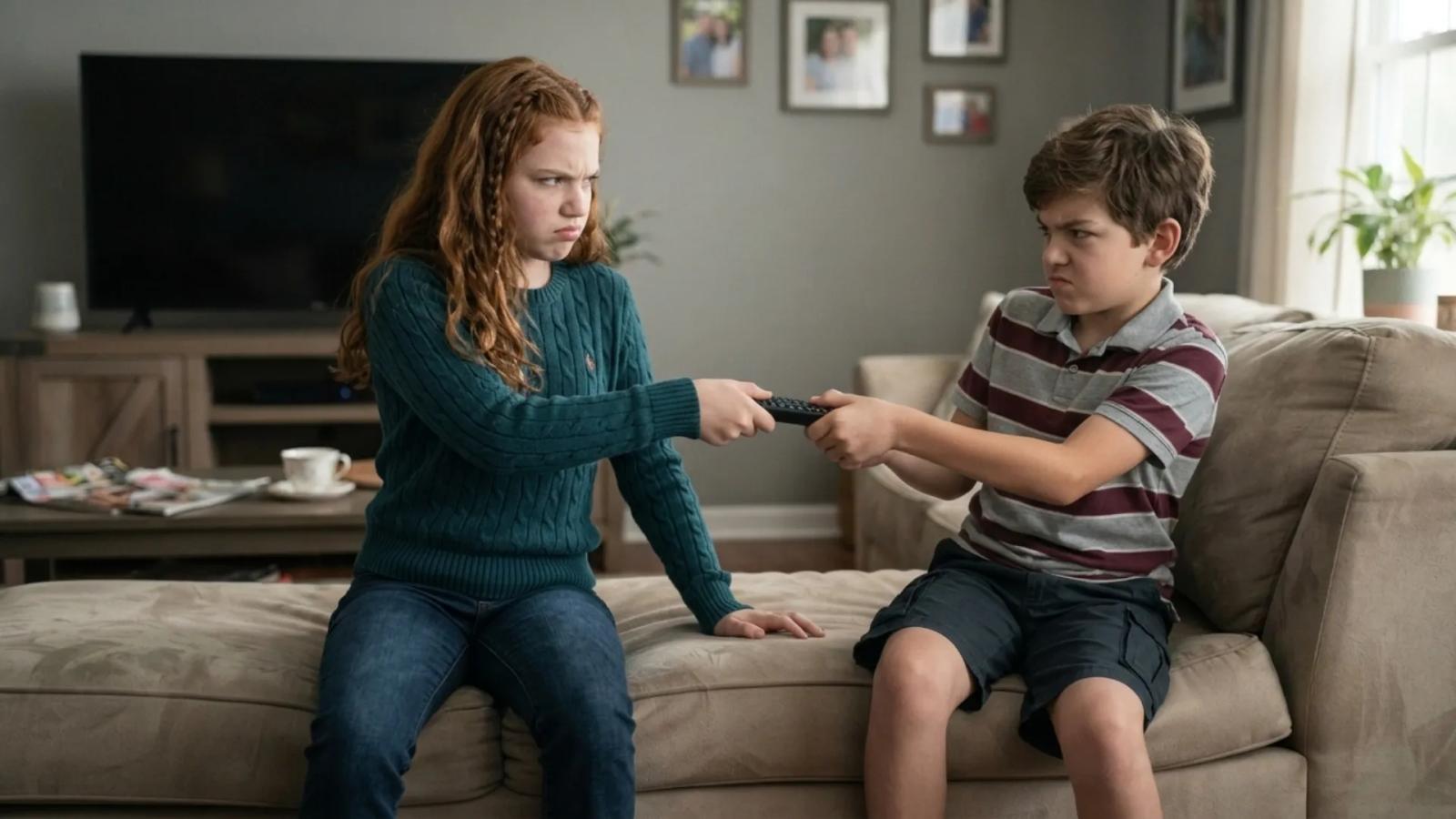
They fought over the remote. Over who got which chair at the table. Over who got in the car first. Over who looked at the other one in a way the other one didn’t like.
And there you are in the middle, trying to figure out who started it, who’s right, and what to do with two people shouting completely different versions of the same event.
Sibling fights are one of the most exhausting experiences in family life. Not because of the fight itself, but because of what it pulls out of you: the pressure to be fair, to fix it, to guarantee that peace is possible in this house.
The good news is that you’re probably trying to do something that isn’t actually your job. And when you stop trying to do that thing, everything gets a little simpler.
(Not much simpler. But a little. And on a long day, a little is something.)
The problem with trying to figure out who’s right

It seems simple: if you just figure out who started it or who messed up more, you can be fair, punish the right one, comfort the other, and be done with it.
The problem is that this logic doesn’t work for three fundamental reasons.
The first: you almost never have enough information. Each child will tell the version that favors them. Not out of dishonesty, but because it’s genuinely the version each one sees. What looks like a lie is, most of the time, just a matter of perspective.
The second: even when you find the guilty party, the solution doesn’t fix the real problem. What generated the fight (the need for attention, accumulated frustration, jealousy, tiredness) is still there. The next one is twenty minutes away.
The third is big: judging actually makes things worse. If kids know you’re going to step in and decide who ‘won,’ the fight turns into a contest for your attention. That’s how arguments get louder, longer, and harder to stop.
(You’re not a judge. Which is fortunate, because the sibling tribunal is the only court where both parties always have irrefutable proof that the other one started it. At the same time. With eyewitnesses who didn’t see anything.)
What the fight usually is, and what it looks like
The surface of the fight is rarely the real issue. The remote isn’t about the remote. The chair at the table isn’t about the chair.
It’s about who has more power, who matters more, who the parents will defend, and who has more space inside this family.
This doesn’t mean you have to analyze every fight. But if you only deal with what’s on the surface and ignore what’s really going on, you’re just putting a band-aid on it—the next fight is coming soon.
(The fight over the last cookie in the bag is rarely about the cookie. But you also don’t need to stop dinner to explore that theme. It just helps to know the cookie is a symbol. A very crunchy, very contested symbol.)
Step in, or let it go?
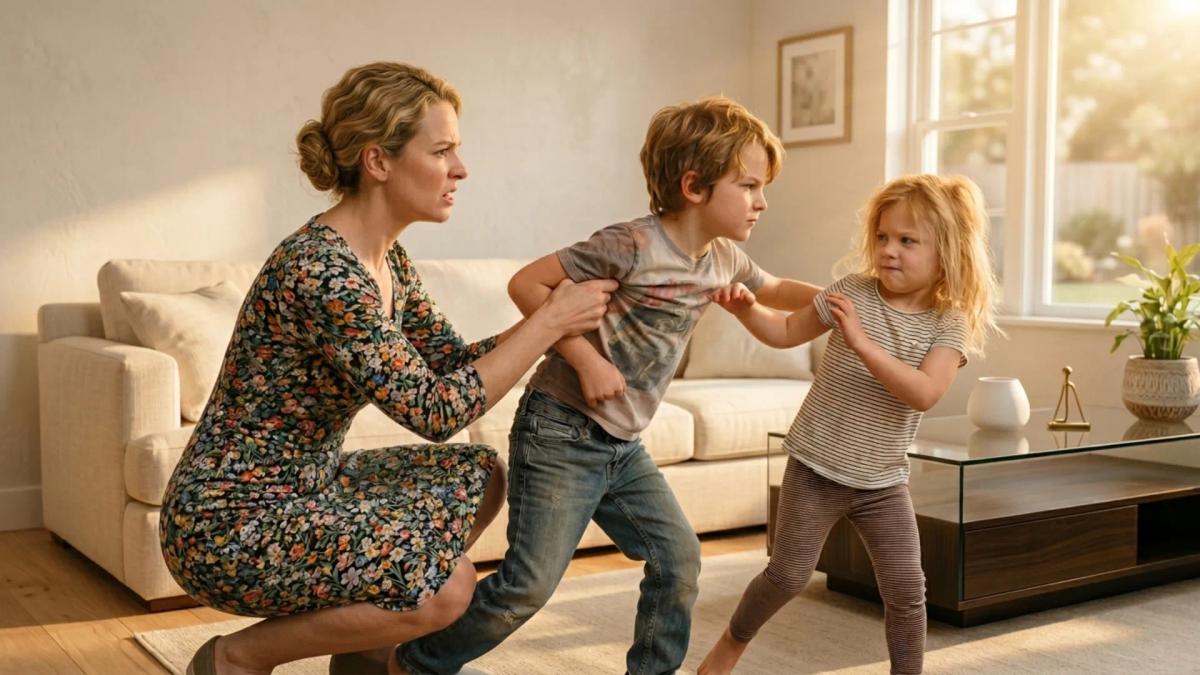
There’s no single answer. But there’s a useful guideline: the criterion for stepping in shouldn’t be the volume of the fight, but what’s happening inside it.
When not to intervene;
- Verbal fights where both can still minimally hear each other.
- Disagreements about games or activities with rules can be worked out by themselves.
- Conflicts where both have roughly equal power in the situation.
Letting them resolve it themselves builds negotiation skills, frustration tolerance, and the capacity for repair.
When to intervene;
- When there’s a risk of physical harm.
- When there’s a significant power imbalance (one much older, stronger, or more verbally skilled than the other).
- When the fight has already gone beyond both children’s emotional control, and neither can listen anymore.
(Volume is not the thermometer. Some screaming fights resolve themselves in three minutes. Some quiet conflicts need an adult. Learning to tell the difference will save you a lot of energy over the years.)
How to mediate without becoming the jury
When you decide to step in, how you enter the fight shapes everything. A few guidelines:
Step in to regulate, not to judge
“I can see you’re both really angry right now” is different from “Who started it?” The first position is that you are an emotional regulator. The second makes you a referee, and all referees get contested.
Separate before you solve
Two dysregulated brains in the same space can’t negotiate. One breathes in the kitchen, the other in a bedroom. Only after both have come down does the conversation have a chance of going somewhere.
Validate both, without resolving through judgment.
“You got angry because you thought it was your turn.” “You were upset because you felt like he wasn’t respecting you.” Validating isn’t agreeing with both at the same time. It’s showing that both experiences exist and are real, even if they’re incompatible.
Ask the right question.
Instead of “Who started it?” try “What does each of you need right now for this to get resolved?” That question shifts the focus from blame to solution; it’s surprisingly effective even with young children.
Let the solution come from them whenever possible.
“What do you two think would be fair?” Children who participate in the solution are far more likely to follow through, rather than those who receive a ready-made solution from an adult.
Set limits on the behavior, not the emotion.
“It’s okay to be mad at each other. But you can’t hurt each other.” Feeling things is fine, but some actions are off-limits. Both can be true at once.
(You don’t need to come out of the fight with a declared winner. You need to come out with both of them regulated enough to keep going with the day. Sometimes that’s all that’s possible, and it’s already a lot. Especially for you, who deserves a coffee after all of that.)
What to do with the fight that never seems to end

Some families have a pattern of fighting that feels structural: the kids fight about everything, all the time, with an intensity that wears everyone down. When this happens, it’s worth looking beyond the fight itself and asking what’s feeding the pattern.
Too little individual time with each child. When each one feels like parental attention is a scarce resource, sibling competition intensifies. Creating exclusive moments with each child separately reduces the sense of scarcity that fuels rivalry.
The fights are generating attention. If every fight calls the adult in and puts both kids at the center, the fight becomes an efficient attention mechanism. It’s worth noticing whether you respond more to the fight than to the peaceful moments between them.
General tiredness or overload. Children with low emotional resources fight more. Overstimulating weeks, routine changes, and adjustment periods all reduce mutual tolerance. The fight is the symptom of something that started earlier.
(If the fighting pattern is very intense and isn’t shifting over time, a conversation with a mental health professional is a valid tool. Not because something is wrong with your children, but because sometimes a pattern needs an outside eye to be seen clearly. And because you’ve also hit your limit, and that counts too.)
What fights teach, when we let them
There’s something that only happens in conflicts parents don’t resolve: real learning about how to live with other people.
Negotiation, frustration tolerance, the ability to give ground without feeling defeated, understanding that the other person’s needs exist and deserve space: all of this develops through friction, not despite it.
Siblings who are constantly arbitrated by adults don’t develop these skills the same way. They learn to call in the adult rather than resolve things between themselves.
Letting the fight play out isn’t easy, but it’s worth it. The payoff comes later.
(Siblings who learn to fight and reconcile on their own are practicing one of the most complex skills of adult life. You’re not being negligent when you don’t step in. You’re giving them space to practice. Even if that space is the entire living room.)
In the end
Sibling fights are not going to stop. They’re part of what it means to grow up sharing space with someone you didn’t choose, someone who is completely different from you, or frighteningly similar, which is sometimes worse.
What can change is what you do with them. When you stop trying to be fair and start being a regulator, when you stop looking for the guilty party and start looking for what’s underneath, when you stop solving and start facilitating, the dynamic shifts.
Not all at once. Not permanently. But enough to make the house a slightly less exhausting place for everyone.
(Including you, who is also tired of hearing your child’s sibling’s name said in that tone.)
FAQs
Should I always hear both sides before stepping in?
In the heat of the fight, hearing both sides rarely works because neither is in a state to be heard or to listen. What works is regulating first, separating when necessary, and only once both have come down, bringing in the conversation about what happened. Listening after the heat has dropped opens far more than listening in the middle of the storm.
What if one is clearly more aggressive than the other?
When there’s a clear pattern of one child being consistently more aggressive, physically or verbally, that deserves specific attention, separate from the fight itself. Not as punishment, but as a conversation: what’s happening with him that makes this the form he found? Repeated aggression is often a sign that the child isn’t managing to process it any other way.
How do I respond when they call me to resolve it and I don’t want to get involved?
With honesty and a clear redirect: “I can see you’re having a hard time. I’m sure you two can find a way to work it out. Come get me if someone gets hurt.” Said calmly, without irony, this teaches that a fight doesn’t automatically summon the adult, and that you trust their ability to resolve things.
Are sibling fights different when there’s a big age gap?
Yes. When there’s a significant age or developmental difference, the power balance is unequal by definition, and the responsibility to navigate that more carefully falls more on the older one. That doesn’t mean they’re always at fault, but it does mean the expectations for self-regulation are different. The older one can do more, so more is expected of them.