Good stories do something very particular for children.
They create wonder, but they also create just enough tension for a child to feel something complex in a safe way. A story lets them come close to fear, separation, uncertainty, courage, and relief without having to experience all of it directly.
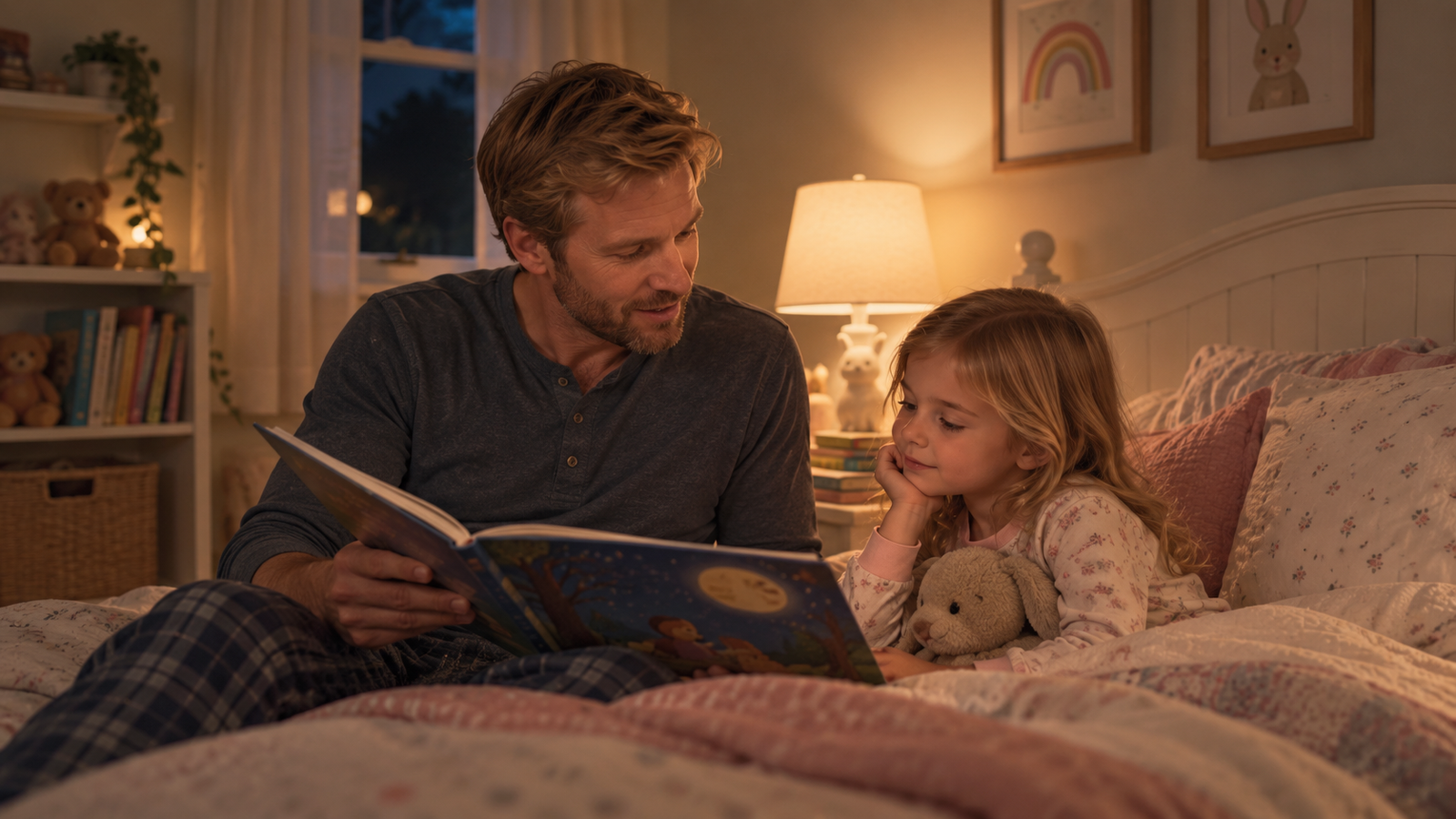
I saw this clearly while reading 101 Dalmatians to my daughter.
She was completely absorbed in the story. Her eyes were fixed on the page, her body still, her attention fully inside that little world.
But at the same time, I could see that she was quietly distressed.
Not because of the villains. Not because of the danger.
What unsettled her was something much simpler and much deeper: the puppies had been separated from their parents.
Someone had taken them away.
Her reaction made immediate sense.
For a young child, separation does not always register as temporary. Ever seen your child collapse into tears after you drop them off at daycare? It can feel much more fundamental for them, like a kind of Big Deal loss.
So, deciding to stay within her developmental window, I did not try to talk her out of the feeling.
I let the story do the work for me instead.
First, I kept pointing gently toward the ending.
“Look, everyone is happy at the end. Everything ends well. Look how happy they are together again.”
I made it playful. I cheered. I tickled her a little. “Yay!”
She joined me, giggling, and I could see the relief move through her body.
Then I underlined something deeper, something essential to the story.
“See? Mommies and daddies always go looking for their kids. They always find them. They always come back.”
And then I made it personal.
“So you never have to be afraid if Papa and Mama are not there for a moment. We will always find you. We will always come back.”
“Promise?”
I did, and I kissed her forehead and hugged her close.
Her face changed almost instantly. Her little frame softened into me, and she smiled.
The story had given me something I could not have argued into existence.
Proof, in her own world, on her own terms.
That is part of the magic of storytelling.
A story can show them a lesson in a way direct explanation often cannot. It bypasses the part of a child that wants to resist being taught and speaks instead to the part of them that is watching, feeling, connecting, and making meaning.
The book showed her something.
The puppies were lost.
Their parents searched.
They were found.
They came back together.
And because she could see it, feel it, and return to it night after night, the idea became more than reassurance.
It became a small internal anchor.
What surprised me most was how useful that anchor became later.
Because our schedule is busy, goodbyes can sometimes be hard. There are mornings when she wants one more hug, one more minute, one more reason for me not to leave yet.
We do have a goodbye ritual, but that is a story for another time.
Now, when she hesitates and I feel the old resistance starting to build, I do not immediately negotiate or distract her.
I ask one simple question:
“What do mommies and daddies always do?”
And more often than not, I can see the moment it clicks again.
Her face changes.
“They always come back.”
That sentence has become a bridge.
This is not a trick. We always do come back.
It is meaning. In a way they can understand.
And when we repeat the same language at the right moment, the story starts to become part of everyday structure.
A practical takeaway for parents
If your child has a recurring fear, you can sometimes use stories as emotional scaffolding.
Not every fear needs a big conversation. Sometimes, what helps most is a story where the feeling appears, moves through tension, and resolves clearly enough for your child to understand.
You can try this:
- Name the fear instead of dismissing it. Separation anxiety is not irrational. It is developmental.
- Use stories as emotional scaffolding. Fiction can help children internalize truths they are not ready to process through explanation alone.
- Create one repeatable sentence. Simple, consistent language can become an emotional anchor.
- Let your child complete the idea. When they say the sentence themselves, they start to own the meaning.
Choose one recurring fear your child has.
Find, or gently frame, a story where that fear is resolved in a clear and comforting way. Then repeat the same sentence when that fear shows up in real life.
It does not need to be complicated.
Sometimes one sentence is enough.
They always come back.
And after hearing it enough times, maybe your child starts to believe it from the inside.