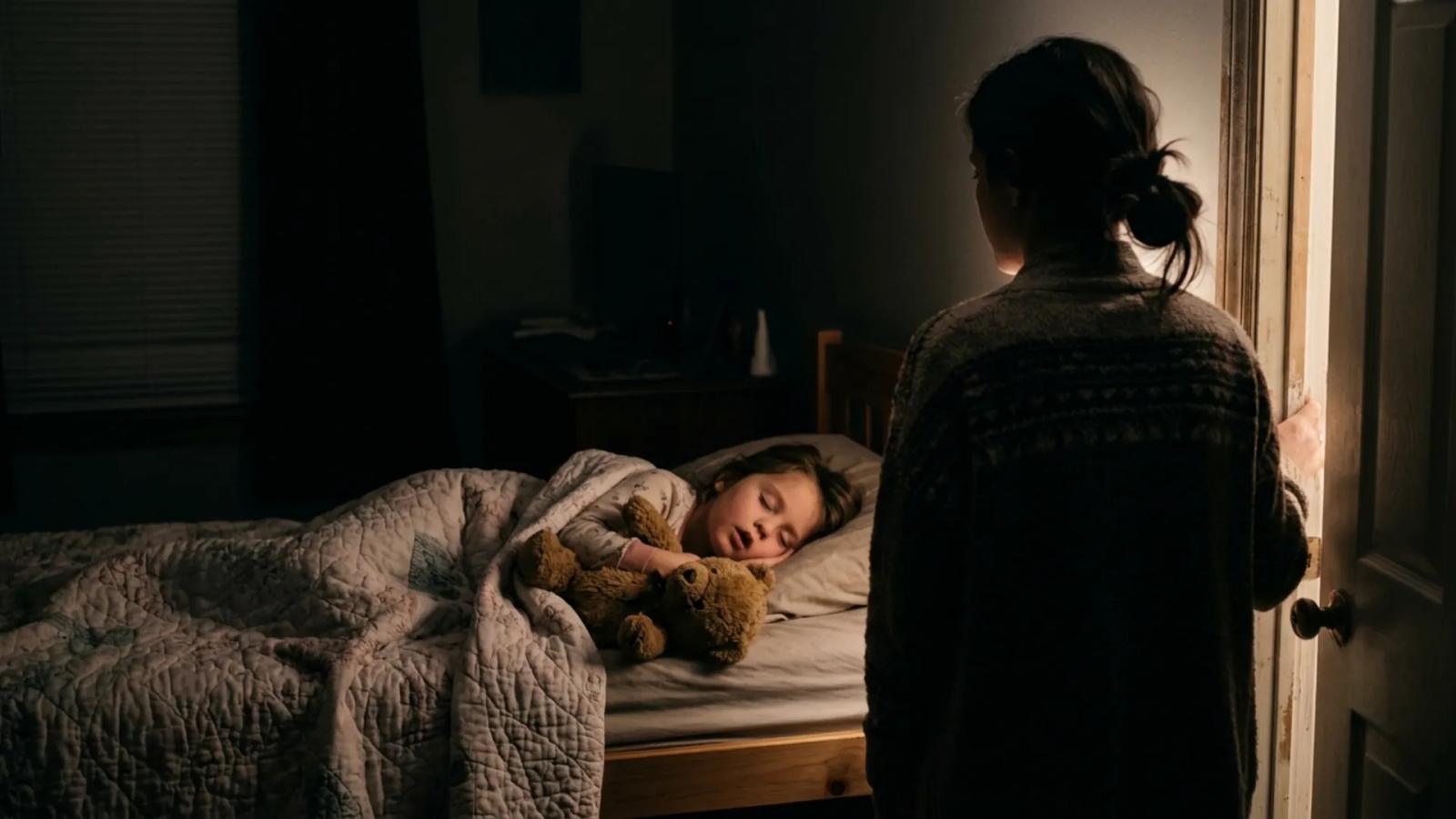
You turned off the light, tucked in the blanket, gave the goodnight kiss, and headed for the door.
And then, he spoke.
Nothing serious, just something that happened at recess, a story he’d been holding onto all day, or something deeper like a “do you still love me when I’m angry?”
This moment when your child starts sharing things they didn’t tell you earlier, precisely when you’re no longer looking them in the eyes, has a name and an explanation.
And it might be the most important moment of your day.
Why nighttime opens what daytime couldn’t

During the day, kids are in performance mode.
At school, they’re managing rules, relationships, transitions, and expectations. At home, they’re answering questions, reacting to boundaries, and navigating conflicts. The brain is running on high demand all day long.
At night, when the pace slows down, something shifts. The body relaxes, the vigilance does too, and what’s been held back for hours finally starts finding its way out.
Researchers who study children’s emotional behavior describe this phenomenon quite directly: the dark, quiet bedroom reduces social pressure and lowers defenses.
No audience. No demands. Nothing to prove. The child simply exists.
And in existing, they talk.
It’s no coincidence that the hardest questions come up in this moment: “Is grandma going to die?” “Are you and Dad going to split up?” “Why didn’t that kid want to play with me?” These questions were waiting for the moment she felt safe enough to let them go.
(And the moment she felt safe enough? It was right when you were about to leave the room. There’s some irony in that — but also something really beautiful.)
The day was full of friction, and the night that reset everything
It might not have been a good day. There could have been a fight at dinner, tears when it was time to leave the park, a punishment that felt unfair to her, or a moment when you lost your patience, leaving a quiet sting in your chest afterward. And yet, she called for you.
This is one of the most counterintuitive things about childhood: the child who pushed your limits the hardest during the day is often the same one who, at night, seeks you out to reconnect.
She hasn’t forgotten the conflict. But her attachment to you is stronger than the friction, and the need to feel that the relationship survived the hard day is real and urgent for her.
When you stay, even just for a few minutes, you answer that question without saying a word: we’re okay. I’m still here.
(You might have gotten it wrong out loud three times today. And still, at night, the address she knows by heart is you.)
What’s happening in her brain as she falls asleep

The period just before sleep has specific neurological qualities: as the body starts to slow down, the state of wakefulness gradually gives way to something in between — not quite awake, not quite asleep.
In that state, the mind becomes more receptive and less reactive.
That’s why what’s said in this moment tends to land differently. Simple things like “you are loved,” “I’m so glad I’m your dad,” “you can sleep now, I’m here” arrive with less noise and more depth.
Research on nighttime parenting shows that an adult's emotional presence at bedtime is linked to stronger emotional regulation in children.
What that means: her nervous system just received a safety signal at a moment when it was especially open to receiving it.
(In other words, what you do in these ten minutes carries a weight that goes well beyond those ten minutes.)
How to be present without needing to fix anything
When a child says something heavy at night, the temptation is to solve it — to give a complete answer, make sure she understands, and reassure her once and for all.
But what she usually needs isn’t resolution. Its presence.
There’s a real difference between listening to respond and listening to be there. The child asking about death at 9 pm probably doesn’t need a philosophical explanation.
She needs to feel that her question didn’t scare you. That she can have this kind of conversation with you. That bringing it up won’t close the door between you.
Some of the best possible responses are the simplest ones:
“I’m really glad you told me that.”
“Good question. Let me think about it with you.”
“I don’t have all the answers, but I know I’ll be here.”
Responses like these don’t close things off. They open them up. And a conversation that opens is the kind she’ll want to have again.
(You might not know how to answer questions about death at 9 pm. But the fact that you didn’t run from it? That she won’t forget.)
When silence is also a conversation

Not every goodnight needs big words.
Sometimes this is all it is: you sit on the edge of the bed, she stares at the ceiling, and the two of you spend some time together without saying anything world-changing.
She asks for a glass of water. You get it. She asks a silly question about a cartoon character. You answer.
And even then, when you finally turn off the light, something was said.
It was said that you have time for her. That the day might have been chaotic, but this moment is hers.
That the world outside might be loud, but in here it’s calm.
Attachment isn’t built only in big moments. It’s built on the repetition of small ones.
And the bedtime ritual is one of those moments that, accumulated over years, forms something she’ll carry long after she’s forgotten what you actually talked about.
What to do when you’re exhausted too
Let’s be honest: at 9 pm, after a long day, the last thing that feels possible is being the emotionally available adult this moment calls for.
You’re tired. You want her to sleep. You have things to do once her eyes close.
That’s real, and it doesn’t change what the moment asks of you.
What can help is knowing that presence doesn’t have to be perfect to be enough.
You don’t need to be ready for a deep conversation every night. You just need to show up. Stay. Put the phone down and look at her for a few minutes with your head a little emptier than full.
Some nights it’ll come easy. Others, you’ll be so drained it’ll feel almost mechanical: blanket, kiss, lights out.
And that’s okay.
What matters is the pattern over time, not the quality of any single night.
(You showed up. Exhausted, half on autopilot, with half your brain still stuck on that 6 pm email. But you showed up. That counts.)
In the end
The bedtime conversation that really matters rarely feels important while it’s happening.
It’s just you on the edge of the bed, her with the blanket up to her chin, a question that came out of nowhere, a story she’d been holding since lunch…
An “I love you” whispered before she closed her eyes.
Small things that, added together, build the certainty she carries: this adult is here. I can talk. I’m safe.
That certainty doesn’t need a speech to exist. Sometimes it fits entirely in ten minutes in the dark.
(If you’re reading this, you’re probably already the kind of parent who stays. Who shows up? Who, even when exhausted, still wonders if you’re doing enough. It might not feel like much. To her, it’s everything.)
FAQs
What do I do when my child uses bedtime to stall?
There’s a difference between a child who’s processing the day and one who’s testing limits. The one processing usually has something concrete to say, even if it takes a little while to come out. The one stalling tends to change the subject as soon as the previous one gets addressed. Recognizing the pattern helps you decide when to stay and when to hold the line on bedtime.
What if I don’t know how to answer what she asked?
Not knowing is a valid and honest response. Saying, “I’m not sure, but I can think about it, and we can discuss it tomorrow,” conveys more than a fabricated answer. It also demonstrates that uncertainty is not a weakness and that some questions deserve more time and thought rather than a quick response.
How long does this moment need to last to count?
There’s no magic number. Research on nighttime parental presence shows that what matters isn’t duration, but the quality of presence during that time. Five minutes of real attention is worth more than twenty minutes of being physically there while your mind is somewhere else.
What about the days when I really couldn’t be present?
It happens. Travel, long shifts, days that fell apart. When being there physically isn’t possible, a quick call before bed, a voice message, or a ritual coordinated with another adult in the house can cover part of the role. What the child needs to feel is that she was remembered, even from a distance.
Does this change as kids get older?
In the early years, the ritual of talking before bed is more important than the content of the conversations; simply being present is what matters most. Between the ages of five and eight, conversations deepen in substance, questions become more complex, and the opportunity for open dialogue still exists, although it may be shorter. During the pre-teen years, this opportunity might temporarily disappear, but it often returns in a different form. One consistent pattern is that a child who has learned to talk before bed will eventually continue this habit.