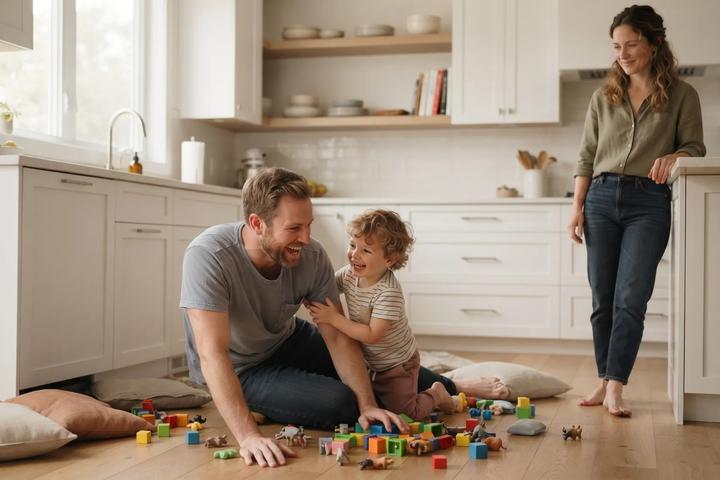
If I could sit down with myself at the very beginning of this whole parenting experience, before the sleep deprivation, the second-guessing, that quiet feeling that everyone else somehow got a manual I missed, I do not think I would bring a book.
I would not bring a framework, a method, or a neatly packaged set of rules that promised to make everything easier.
I would probably sit there for a moment, let the silence settle, and say something much simpler:
“You are going to care even more than you think.”
And that will be both the most beautiful part of this and, at times, the heaviest.
Because so much of what matters in parenting does not fully land when you hear it. It lands when you live it.
It lands when you are tired, when you are trying again, when you are standing in your kitchen wondering whether this small moment is actually small or whether it is about to become one of those memories you replay later.
There are things you only understand from the inside.
1. Your child is not a problem to solve
One of the easiest traps in parenting is to start seeing everything through the language of problems.
- A sleep problem.
- An eating problem.
- A behavior problem.
And of course, sometimes there are real problems that need attention. That part matters.
But often, what is happening is not that your child is a problem. What is happening is that your child is a person in development, growing in real time, with an unfinished brain, limited life experience, intense feelings, and very few tools for managing any of it neatly.
They are learning many things at once, and rarely at the same speed. Some parts move quickly. Others take longer. Some are shaped by temperament. Some by timing. And some even by what is happening around them that day, that week, or in that season of life.
When you stop approaching your child as something to fix and start approaching them as someone to understand, your whole stance begins to change: you react less to the surface of what is happening and become more curious about what may be sitting underneath it.
That shift matters more than it may seem at first.
Partly because parents assign meaning all the time, often without realizing it.
You decide what becomes a major concern, what gets interpreted as a passing phase, what deserves intervention, and what needs patience. A small behavior can become a recurring family story if you keep feeding it with the wrong meaning.
If you decide that your child is not having a phase of slow food discovery, but rather, is a picky eater, the problem will worsen. You will treat them as a picky eater, might even call them a picky eater. And they will believe you. And the problem will be made manifest.
At the same time, something that looks small can grow into a bigger issue if you keep dismissing it because it feels easier in the moment.
Is your child just tired, or are you correctly perceiving that they are starting a habbit of whining? If so, target the behaviour, not the child.
Parenting asks you to interpret constantly, and those interpretations shape the atmosphere your child grows inside.
It also matters because your child is watching you far more than they are listening in the way adults hope they will. Parents repeat themselves endlessly, and still the deeper lessons often come through tone, reaction, posture, habit, and emotional rhythm.
Children absorb what we do with frightening efficiency. They notice what rattles us, what calms us, what we exaggerate, what we avoid, and how we make sense of the world around us.
And then there is the more uncomfortable part, which many parents recognize once they are willing to admit it: your child can reflect your expectations back to you.
If you have quietly decided that your child is difficult, stubborn, dramatic, lazy, or impossible, that belief rarely stays private. It leaks into your tone, your assumptions, your patience, your body language, and the way you speak to them before they have even done anything.
Children pick up on that. Over time, they can begin to live inside the role they feel has already been assigned to them.
The reverse can happen too. When a child is consistently seen with more generosity, more steadiness, and more belief in who they are becoming, that also shapes them.
Which is one reason parenting ends up asking much more of us than we expected. A great deal of the work is not only in what we do with our children. It is in what we do with ourselves.
If you want to do right by your child, one of the most useful places to begin is with the way you speak to yourself, regulate yourself, and understand your own patterns.
Children do not need parents who have solved themselves completely. That is not realistic. But they benefit deeply from parents who are willing to look inward with honesty.
2. You will get it wrong, and repair still matters more than people think
At some point, you will lose patience.
You will say something more sharply than you meant to. You will miss what your child needed in a moment. You will handle a situation in a way that looks very different, in hindsight, from the parent you intended to be that day.
That is part of the experience, even though it can feel deeply discouraging when it happens.
Many parents carry a quiet fear that these moments are the ones that define the relationship. That one bad response, one rough day, one moment of disconnection will somehow leave a permanent mark.
What matters just as much, often more, is what happens next.
Do you come back?
Do you take responsibility without turning the apology into a speech about how hard your day was?
Do you show your child that mistakes do not have to end connection, and that closeness can be rebuilt after strain?
Children do not need a parent who never strains the bond. That is not how relationships work, and it is not how human beings work. They need a parent who returns.
A parent who can acknowledge harm, restore safety, and reestablish love without pretending nothing happened.
That return matters.
To a child, especially a young one, the relationship with a parent is not a side relationship. It is the center of the emotional universe. Your child is shaped by your attention, your presence, your emotional availability, and the rhythm of connection between you.
When that rhythm breaks for a moment, repair teaches them something powerful: love can stretch and still come back into place.
And that lesson stays.
When we repair well, children learn that conflict is not the end of closeness. They learn that people can be imperfect and still be safe and that strength is not about never getting it wrong, but about having the courage to return with warmth, clarity, and responsibility.
That does not mean every apology needs to become a big emotional production. Often it is simpler than that. A clear acknowledgement. A softer tone. A gesture of reconnection. Changed behavior. Presence.
Children notice sincerity faster than performance.
There is also something quietly important for parents here: repair is not only good for the child. It protects the relationship from the weight of accumulated distance.
Small ruptures happen in all families. When they go unattended, they harden. When they are met with honesty and care, they soften.
A child who sees a parent repair learns something profound about being human. We are flawed. We get overwhelmed. We misread each other. We fall short. And still, relationships can hold. They can bend without breaking. They can be repaired rather than abandoned.
That is an important kind of safety to grow up with.
3. Boundaries ask for more courage than people think
Sooner or later, many parents run into the same tension.
“If I say no, will I hurt them?”, “If I hold the line here, will I damage trust?”, “If I stay firm, will I become the kind of parent I never wanted to be?”
Those questions can feel surprisingly heavy, especially for parents who care deeply about emotional connection and want their child to feel seen, respected, and secure.
But children are not made safer by the absence of boundaries. They are made more uncertain by it.
A child needs warmth, yes. They also need structure and to know that someone steady is holding the frame when they themselves cannot.
A limit, when it is clear and calm, does much more than stop a behavior in the moment. It helps a child experience the world as coherent. Predictable. Contained. Safe enough.
That does not mean harshness. It does not mean control for its own sake. It means that kindness without steadiness can become confusing, and steadiness without warmth can become frightening.
A parent who never says no does not create freedom.
They often create uncertainty, and sometimes a child who keeps testing further and further simply to find out where the edge is.
On the other hand, a parent who says no constantly, or arbitrarily, creates a different kind of instability. That child learns the world as rigid, unpredictable, or emotionally unsafe.
The goal is something more grounded than either extreme.
A child benefits from limits that make sense, are communicated clearly, and are held without unnecessary emotional spillover. That kind of firmness carries respect inside it. It teaches a child how to live with other people, how to tolerate frustration, how to function in relationships and how to understand that other people also have needs, boundaries, and expectations.
These are not small lessons. They shape friendships, school life, future partnerships, and the way a child eventually moves through the world.
Parents sometimes hesitate to offer that kind of firmness because they worry it will cost them closeness. In reality, children often feel more secure when an adult can be calm and clear enough to lead.
It is not always comfortable to do. Sometimes it goes against your mood, your guilt, your exhaustion, or your wish to avoid conflict for one more hour.
Still, boundaries are part of care.
And sometimes one of the kindest things a parent can do is remain steady enough to say no, without anger, without shame, and without making the child responsible for the adult’s discomfort.
Being firm IS being kind. You are teaching them the playing field in your household. And, related to that, the world. Never saying “no” results in a child that oversteps limits in the real world, at school, with friends and partners. Saying “no” for no reason results in a frustrated and insecure child. Saying “no” where appropriate results in a child who knows how to behave. It sets them up for deep and fulfilling relationships, and success in the world.
Give them this gift. Do them the kindness of being firm.