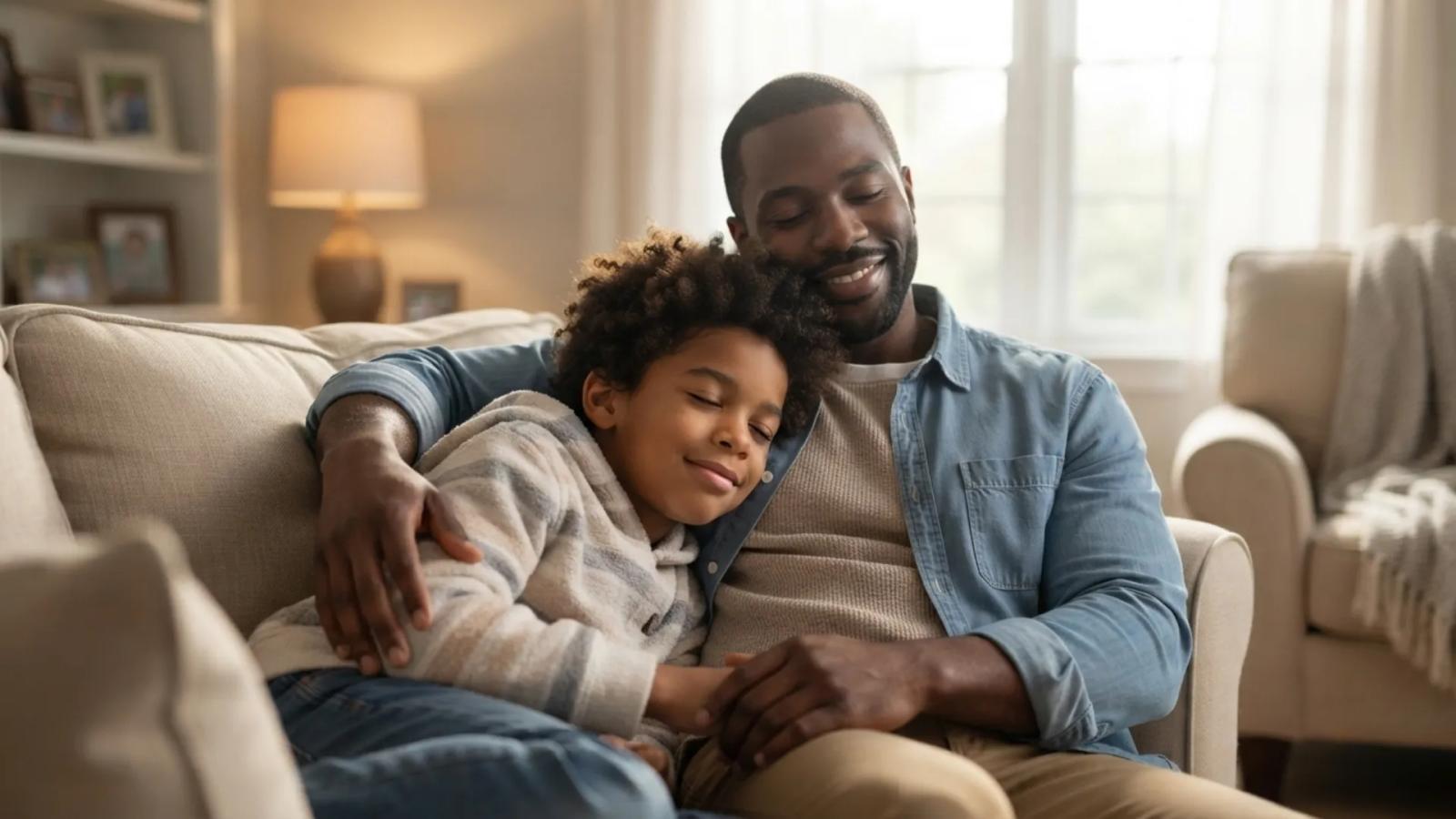
There’s a scene that plays out in many homes and almost never shows up in posts about conscious parenting.
You’re lying on the couch. He comes in, sits down next to you, grabs the remote, and the two of you end up watching something unremarkable for forty minutes.
No deep conversation, no life lessons, no activity.
Just two bodies in the same space, at the same pace, asking nothing of each other.
That’s also a connection. And it’s more powerful than it looks.
The pressure to always be doing something
There’s a dominant narrative about what it means to be a good parent: active presence, stimulating activities, enriching conversations, creative play.
The idea that every moment with your kids should be maximized, extracting as much connection, learning, or development as possible.
That narrative has good intentions. It also creates a specific kind of exhaustion: the feeling that any low-stimulation moment is wasted.
It isn’t.
Attachment science doesn’t describe bonding as something built only through high-quality activities. It describes bonding as something built through repeated moments of presence, and many of those moments are quiet, slow, and apparently empty.
(The problem isn’t doing too little. It’s believing that doing too little doesn’t count.)
What happens when we sit still together
When two bodies share a space without demand, no agenda, no performance, no expectation of productivity, the nervous system relaxes differently than it does alone.
For a child, the calm presence of an adult they love regulates itself. It doesn’t need words or eye contact, just the physical certainty that that person is there, available, in no rush to leave.
Researchers who study emotional co-regulation describe this as “presence as regulation,” the idea that a calm attachment figure’s presence already regulates a child’s nervous system, without active interaction.
In plain terms: being together without doing anything also calms, connects, and matters.
(She doesn’t need you to be at your best. She needs you to be there. Which is, all things considered, one of the most reassuring things science has ever told tired parents on a Tuesday night.)
The many shapes that nothing can take
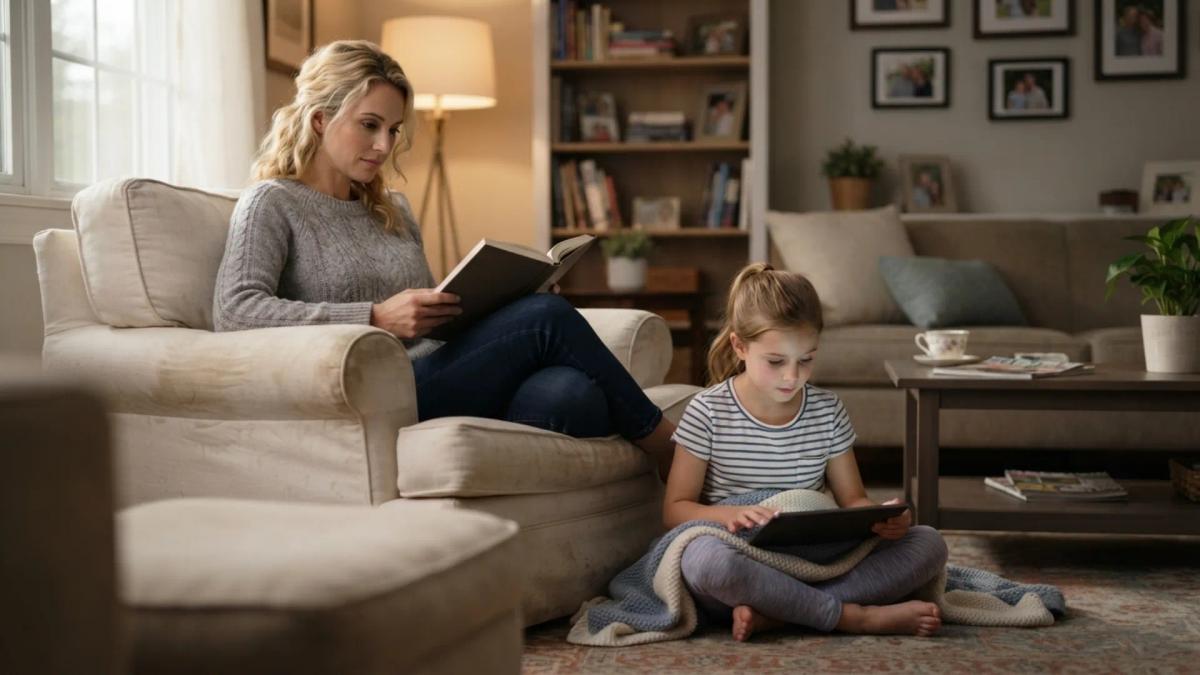
Doing nothing together doesn’t look the same every time. It shows up differently depending on age, temperament, and the day.
Watching something in silence. An episode of a show she chose, a movie you’ve already seen, a nature documentary neither of you asked for, but both of you watched to the end. The content matters less than the fact that you’re both there, at the same pace, sharing the same experience without needing to comment on it.
Keeping each other company in silence. You are reading her drawing. You're answering emails, he's building something. Two parallel worlds in the same room. This kind of presence, what researchers call “parallel play” in young children, though it never really goes away, says something without words: I can be near you without needing anything from you. That’s also intimacy.
Lying around with nowhere to be. On her bedroom floor, in bed, on the couch. No phone in hand, no pending task, just two bodies resting in the same space. For younger kids, this often turns into spontaneous play, and for older ones, into conversation. But even when it doesn’t turn into anything, it was already something.
The shared household task. Folding laundry together, cooking in silence, washing dishes while she dries. It’s not an activity designed to create connection; it’s real life happening with two people in the same space. And that, repeated over the years, becomes emotional memory.
(Some of the strongest memories people carry from childhood aren’t of grand moments. They’re of the smell of the kitchen on a Saturday afternoon. The sound of the TV while they fell asleep on someone’s lap. The feeling of being close without needing to say anything.)
Why is it hard to allow
For many parents, sitting still next to their child without doing anything productive activates an uncomfortable inner voice: “I should be making better use of this time.” “We need to talk more.” “I should be teaching them something!”
That voice comes from several places: productivity culture, the guilt of a parent who works a lot, and the pressure to be present in the active, engaged sense of the word.
But it confuses two distinct things: presence and performance.
Presence is being there. Performance is demonstrating that you’re there in a way that looks like enough. They’re different, and more often than not, it’s the first one, not the second, that a child actually feels.
(She doesn’t need you to be a movie dad. She needs you on the couch next to her while the show plays.)
What low stimulation teaches

There’s something that only happens in low-stimulation moments: a child learns to be with themselves while an adult is still there.
That might sound small. It isn’t.
In a world of constant high stimulation, screens, notifications, activities, transitions, the ability to tolerate silence, exist without an agenda, and be okay when nothing is happening is a skill built over time.
And it gets built, in part, by practicing it alongside adults who can do it as well.
When you stay still with her without filling every second, you’re modeling something valuable; that silence is livable, that doing nothing isn’t a waste of time, and that being together doesn’t need a script.
(You’re not wasting her time. You’re teaching her how to inhabit it.)
In the end
There’s no list of activities that guarantees connection. There’s presence, and it takes many forms, including the ones that don’t look like anything.
The shared silence. The divided couch. The afternoon passed without anyone needing to explain what they did.
These moments won’t show up in a photo album. But they’ll show up in her, in the way she learns that being close to you is a safe place to exist without having to do anything to deserve it.
(Some of the best moments with your kids are the ones nobody will remember in detail. Just with the feeling that they were good.)
FAQs
Does this work even for very restless kids who can’t sit still?
Especially for them. Children with high energy or difficulty with self-regulation benefit enormously from the calm presence of an adult, even if they themselves aren’t still. You are on the couch, calm, while she bounces around the room, which is already a form of co-regulation. You don’t need to be still together; you need to be present together.
What if I feel guilty for being on my phone while I’m near her?
There’s a real difference between being physically present but mentally absent, scrolling, answering messages, and being present in a relaxed, low-stimulation way. The phone creates an absence that children notice. If the goal is to share doing nothing, it’s worth putting the phone down, even if only for twenty minutes.
How do I know if this time is actually good for her if nothing is happening?
Watch what comes after. Children who’ve spent time in low-stimulation environments with a present parent tend to be more regulated, more emotionally accessible, and more open to whatever comes next. The indicator isn’t what happened during; it’s how she comes out of that time.
Does this apply to teenagers, too?
Maybe more than at any other stage. Teenagers rarely want planned activities with their parents, but they frequently accept, and even seek out, a quiet presence. Being in the same room, watching something together, riding in silence. Doing nothing is often the only form of connection a teenager can accept without feeling intruded upon.