Have you ever stopped to think that you have less than 10 seconds to react after your child does something?
Almost nobody notices it in the moment, but a lot in parenting gets decided inside a very small window.
It is such a small window that, when the day is chaotic, it practically disappears.
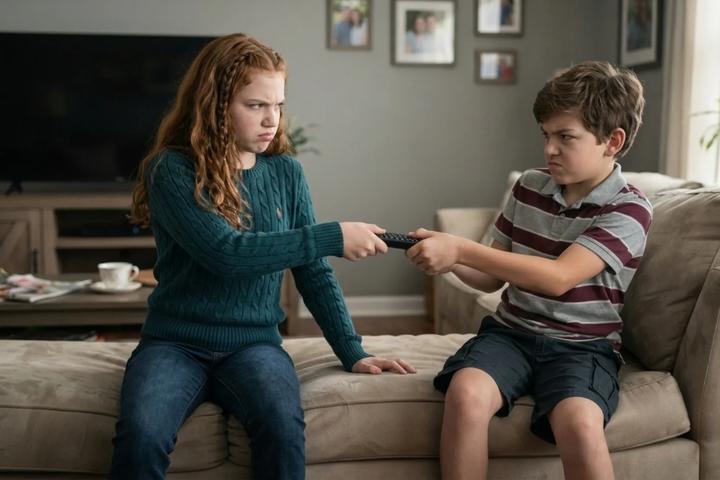
Your son pours water on the floor on purpose. Your daughter answers in that tone. Your child does the exact thing you have already asked them three, four, nine times not to do.
And then comes the reaction. Fast, automatic, usually powered by everything that had already been building long before that scene.
The point is that, in these situations, what really changes things is not some emotionally enlightened version of ourselves that we keep trying to become.
It is what we do in that tiny 10-second gap between the impulse and the response.
What this window looks like in real life
Picture this.
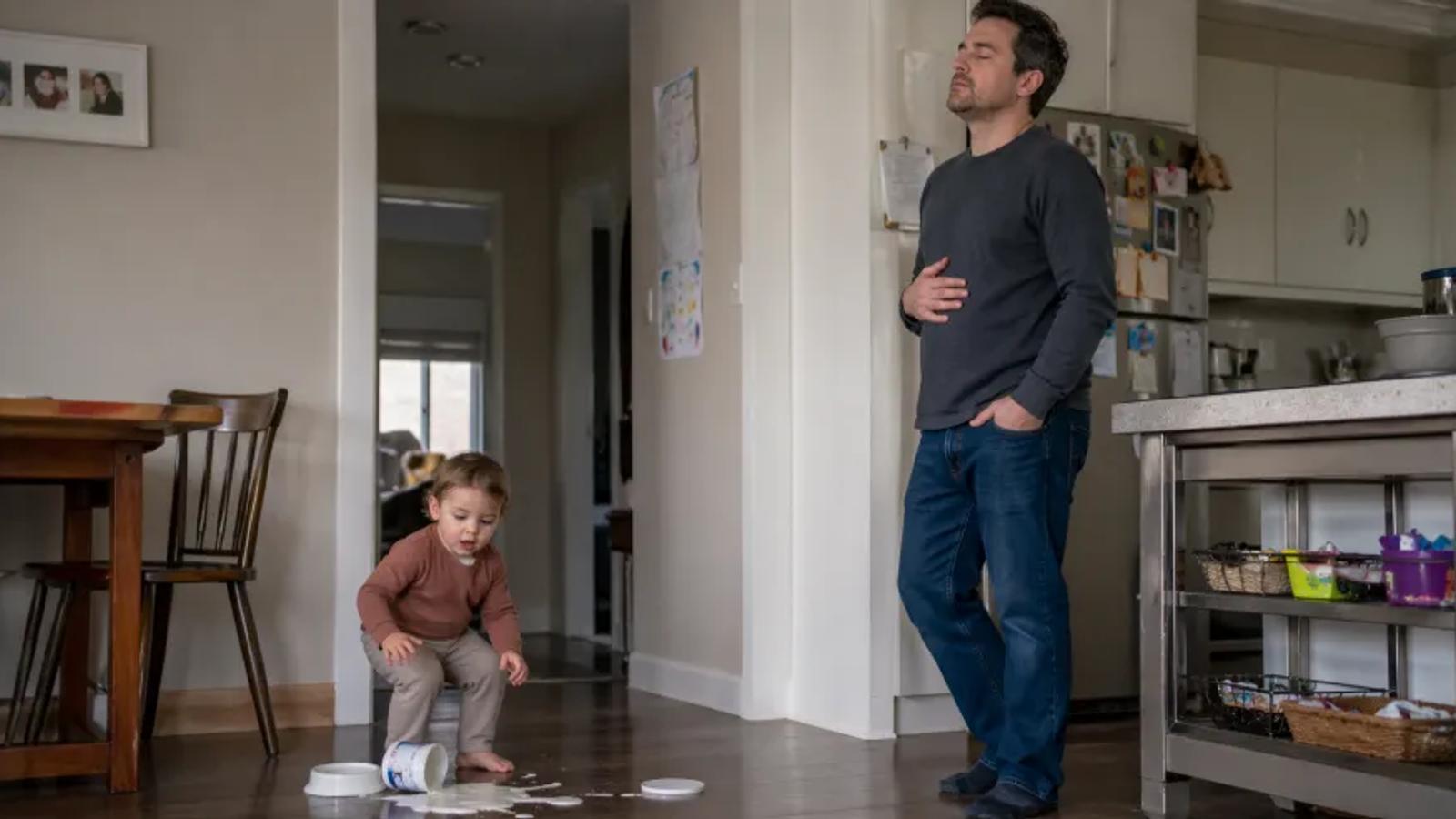
End of the day. You are tired and mentally walking through everything that still needs to happen before bedtime. The house is still kind of messy, the trash has not gone out, and the kids were already in bed until your child gets hungry, grabs a yogurt from the fridge, squeezes it too hard, and somehow manages to get half of it on the floor, on the table, on the counter, and possibly in a parallel dimension.
The whole thing takes two seconds. What happens inside you usually takes even less.
First comes the shock. Not dramatic shock, obviously. More that tiny internal jolt where you look at the scene and think, you have got to be kidding me.
Then comes the instant interpretation: he did that on purpose. I literally just cleaned this.
And if nothing enters that 10-second space, your response comes out glued to that interpretation, louder than necessary, face already set, and there you go: now you have “reacted badly.”
At that point, you are not just cleaning yogurt anymore. You are dealing with yogurt, frustration, guilt, defensiveness, exhaustion, and one more situation that got bigger than it needed to be.
What happens inside us in those few seconds
That window matters because that is where our interpretation picks up speed. And interpretation, in parenting, is a dangerous thing when it gets mixed with exhaustion.
Your child is not always challenging you or “testing boundaries.”
Sometimes they just got the pressure wrong. Sometimes, worst of all, they are simply being a child right at the exact moment when, internally, you were really hoping for the cooperation level of a fully functional adult with basic kitchen awareness.
Noticing this window does not mean turning into an emotional monk.
It means noticing what is happening inside you before your response grabs the wheel and drives off without a seatbelt.
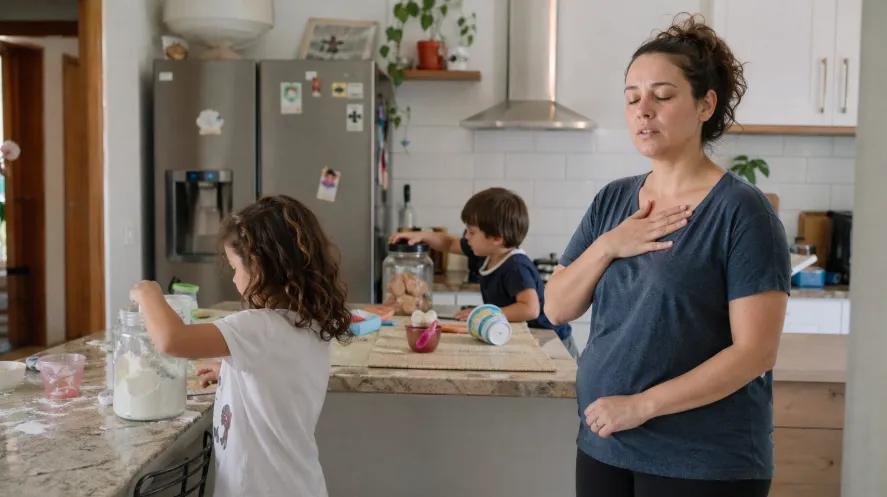
Physically, in those seconds, your thoughts and body react together: your shoulders tense, your chest tightens, your mind races toward a conclusion, and your irritation starts arguing that it needs to come out immediately in the form of your voice, preferably at a volume wildly disproportionate to the actual size of the yogurt incident.
And that is where even a tiny delay can change a lot.
The difference between reacting and entering the situation
It does not have to be a beautiful pause.
Nobody is asking for a commercial-style moment where you close your eyes, breathe poetically, and respond with the kind of serenity that belongs in a mindfulness caption.
Sometimes the pause is simply not speaking at the exact speed your irritation rose.
It is grabbing the towel before grabbing the tone. It is looking at the scene and thinking, even for half a second: what is actually happening here?
Back to the yogurt. In the automatic version, you explode with a “I told you to be careful!” at a volume that is carrying the full emotional budget of the entire day.
In the version with even the smallest opening, you may still feel irritated, because, against all odds, you are a human being and not some evolved entity floating above dairy-based disasters, but maybe you say first: okay, stop. Do not touch anything else.
Or better yet, maybe you do not even answer right away. Maybe you just hand your child a towel.
From the outside, the difference looks small. On the inside, and in the way the scene unfolds, it is huge.
Your child is not only receiving corrections for what happened. They are also receiving the climate. They are learning what adults do when something goes wrong and the room suddenly gets tense.
And you also receive the effect of your own reaction.
Some responses solve the situation. Others multiply it by four and leave emotional leftovers on the counter for later.
How to practice this window without turning it into pretty theory

Those few seconds do not just protect the child. They protect the relationship and, honestly, they protect you too.
A lot of parents are living in such an automatic loop of trigger and response that they only realize what they were feeling after they have already yelled, already felt guilty, already apologized, and are now replaying the whole thing in the shower like emotional VAR footage.
The good news, if we can call it that, is that this window can be practiced in real life.
Inside the mess, too. Not in a perfectly calm house. Not in a happy margarine commercial.
Remembering that your reaction gets built in less than 10 seconds can help you avoid speaking before your brain has even joined the meeting.
It also takes a bit of the weight off your shoulders when you overreact. After all, you had 10 seconds. Sometimes less.
In practice, it is less about counting to 10 and more about not handing the microphone to the worst version of your exhaustion.
What really changes when that pause exists
This may be one of the most underestimated parts of parenting.
A lot of people think difficult interactions are defined by the child’s behavior.
And yes, that matters. But in so many everyday moments, what really determines the tone, the damage, and what lingers afterward is those few seconds when the adult still gets to choose how to enter the situation.
Not choose perfectly. Just a little better.
Because in the end, that 10-second window does not change everything because it is grand or magical.
It changes everything because sometimes it is the only available space between a silly accident and a whole night that tastes like guilt.
And, honestly, there is already too much to clean up in parenting.
If you can avoid also cleaning up the emotional spill from a reaction that could have gone a little differently, that already helps a lot.