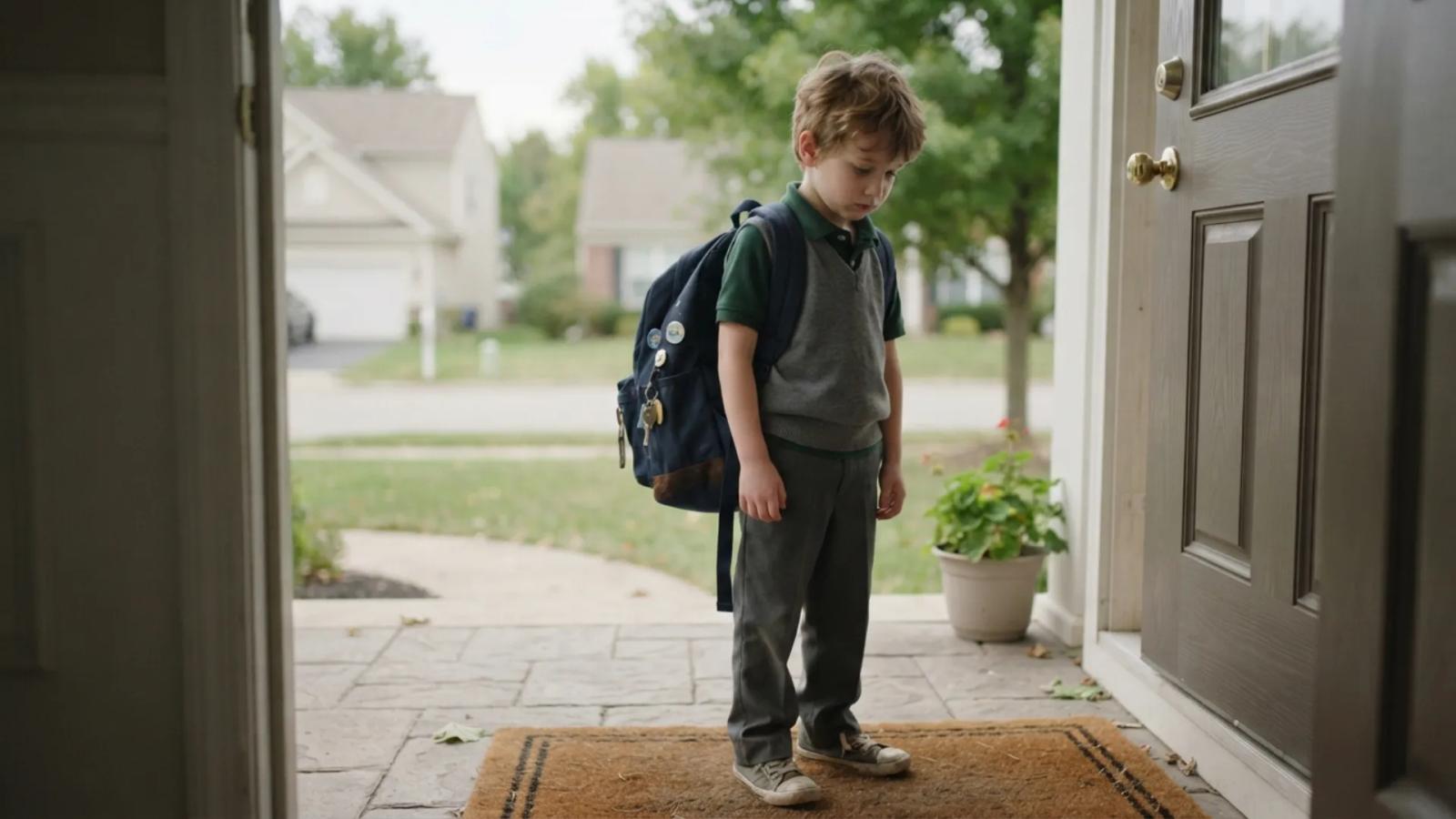
She came home on the first day and said it was great. She ate, took a bath, and went to sleep. In the days that followed, she kept saying everything was fine.
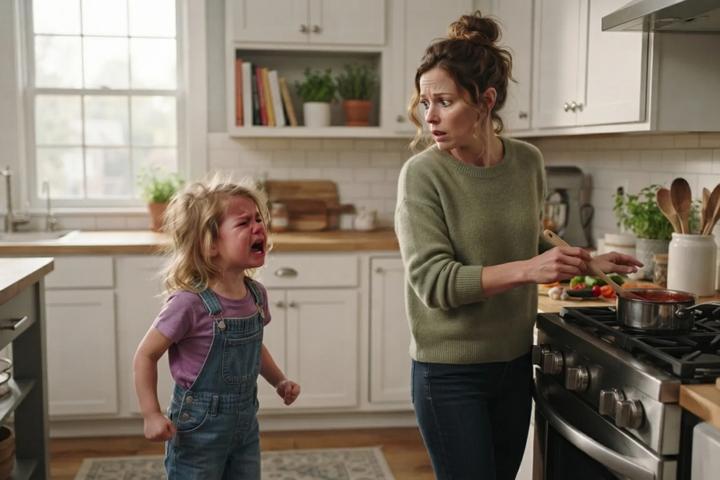
And yet something shifted. She’s more irritable at home. Sleeping badly. Crying over small things that used to pass in seconds. Or the opposite: too quiet, too contained, strangely easy.
You ask if everything’s okay. She says yes. You watch, and you’re not sure.
When a child changes schools, what’s happening on the inside is rarely what shows up on the outside, and understanding that gap can completely change how you support this transition.
Why changing schools is heavier than it looks
From an adult perspective, changing schools is a logical transition. You know the reason, you have the context, you know there’s life on the other side of the adjustment.
From a child’s perspective, it’s something else entirely. She lost, all at once, the environment she knew, the routines that grounded her, the classmates she’d already built a shorthand with, the teachers she already had a history with.
Everything that was predictable became an unknown.
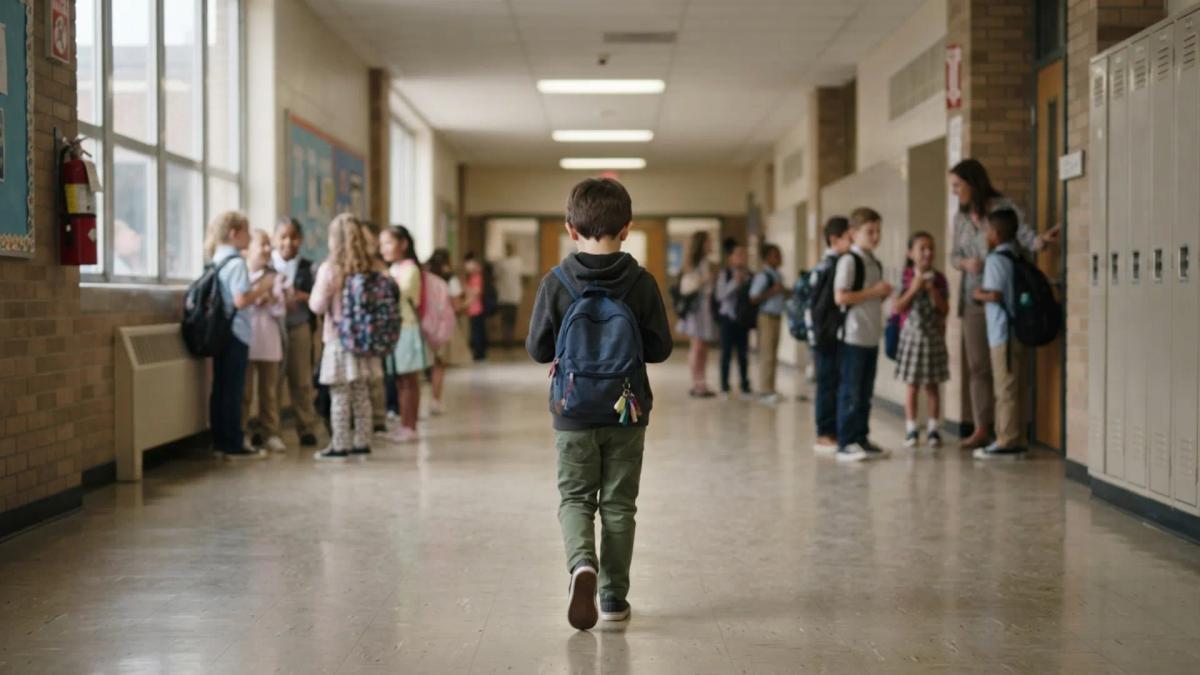
And she still has to function—waking up on time, putting on the uniform, walking into a place where everyone already knows each other except her, figuring out where to sit, who’s who, what the unwritten rules are, and whether there’ll be someone to sit next to at lunch.
All of that while trying to look normal.
(The effort of appearing okay in a new school is one of the biggest energy expenditures a child can have. What makes it home is what’s left over after all of that.)
What “seems fine” often means
When a child says everything is fine after a big transition, she’s usually saying one of three things:
- She really is fine, or at least fine enough for that moment.
- She’s protecting you. She sensed that the change was necessary or hard for the family and didn’t want to be one more burden.
- She doesn’t yet know how to name what she’s feeling, so “everything’s fine” is the only answer she can give while she’s still figuring things out.
All three deserve respect. But the second and third deserve special attention, since they’re the ones most easily missed and the ones that most need an active, present adult.
(A child who’s shielding her parents from her own distress is already carrying more than she should. The signal is rarely verbal. It’s behavioral.)
The signs that speak when she doesn’t
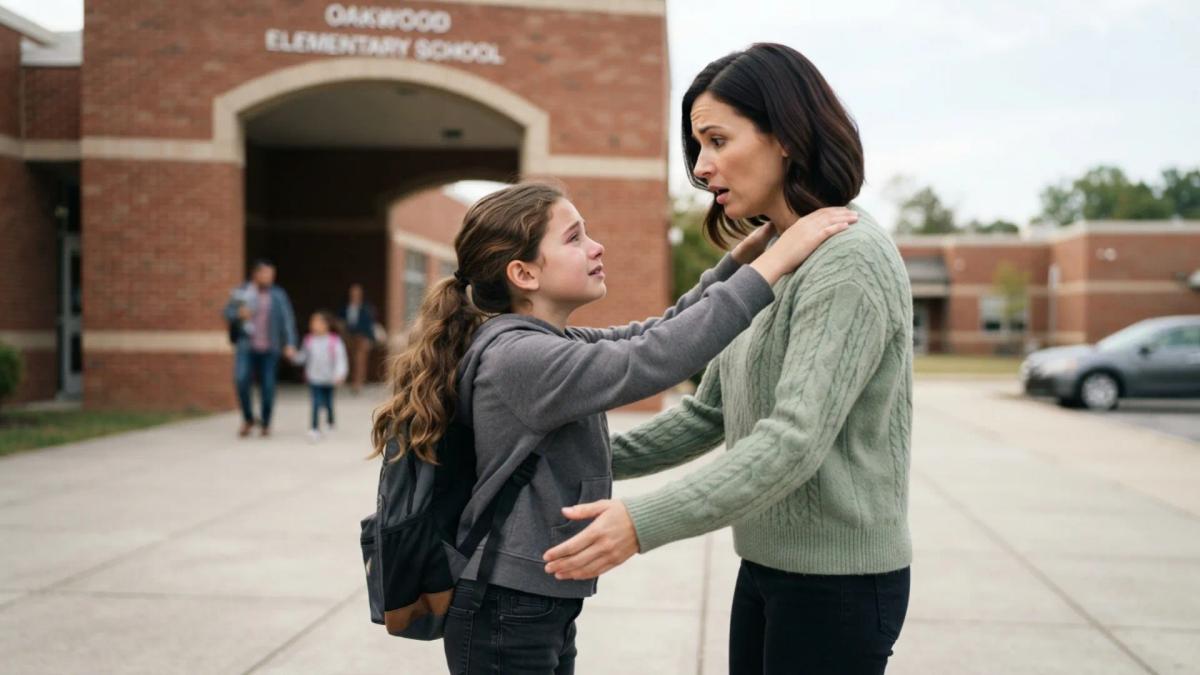
The body and behavior say what words can’t. Some common signs that a child is going through a more intense adjustment than she’s letting on:
Behavioral regression. She goes back to habits she’d already moved past, like asking to be held more often, talking in a more childlike way, or wanting to sleep with you. It’s not manipulation; it’s just her nervous system reaching for what’s familiar when everything around her feels new.
Disproportionate irritability at home. She explodes over small things, has low frustration tolerance, and fights more with siblings. The school used up every ounce of available regulation. What arrives at home is what’s left.
Physical complaints without an obvious medical cause. Stomachaches before school, recurring headaches, and excessive tiredness. The body communicates what the child can’t put into words. These are real symptoms of real emotional overload.
Too quiet or too much. Some children go very quiet after transitions; others become agitated, chatty, or euphoric in ways that feel off their usual rhythm. Both can be signs of an overloaded nervous system trying to regulate itself in different directions.
Sleep difficulties. Takes a long time to fall asleep, wakes up in the middle of the night, and has nightmares. The brain processes during sleep what it couldn’t process during the day, and when there’s a lot to process, sleep is the first place it shows up.
Refusal or resistance to going back. Says she doesn’t want to go, invents reasons to stay home, and cries at the door. It might be reactivated separation anxiety, social fear, or simply the accumulated weight of intense days reaching a breaking point.
(None of these signs is definite on its own. But if any of them persist for more than two or three weeks, it’s worth paying attention—not panicking, just noticing and being supportive.)
What the adjustment period actually looks like
There’s a common expectation that school adjustment follows a linear curve: hard at the beginning, gradually improving, and resolved within a few weeks.
The reality is messier. Many children have great days at first, when everything feels new and exciting, and only start to show signs of overload a few weeks later, once the effort of adjusting builds up and the adrenaline has worn off.
Others seem fine for months and then fall apart when something small changes: a teacher who’s absent, a fight with the one friend they made, a shift in routine.
It’s not that the adjustment wasn’t happening. It was just happening on a more fragile foundation than it seemed.
(The real average for school adjustment is three to six months, not three to six weeks, as many parents expect. That doesn’t mean it’s going to be hard the whole time. It just means settling in can take longer than you might think; something no one tells you at the first-day parent meeting.)
How to stay close without pushing
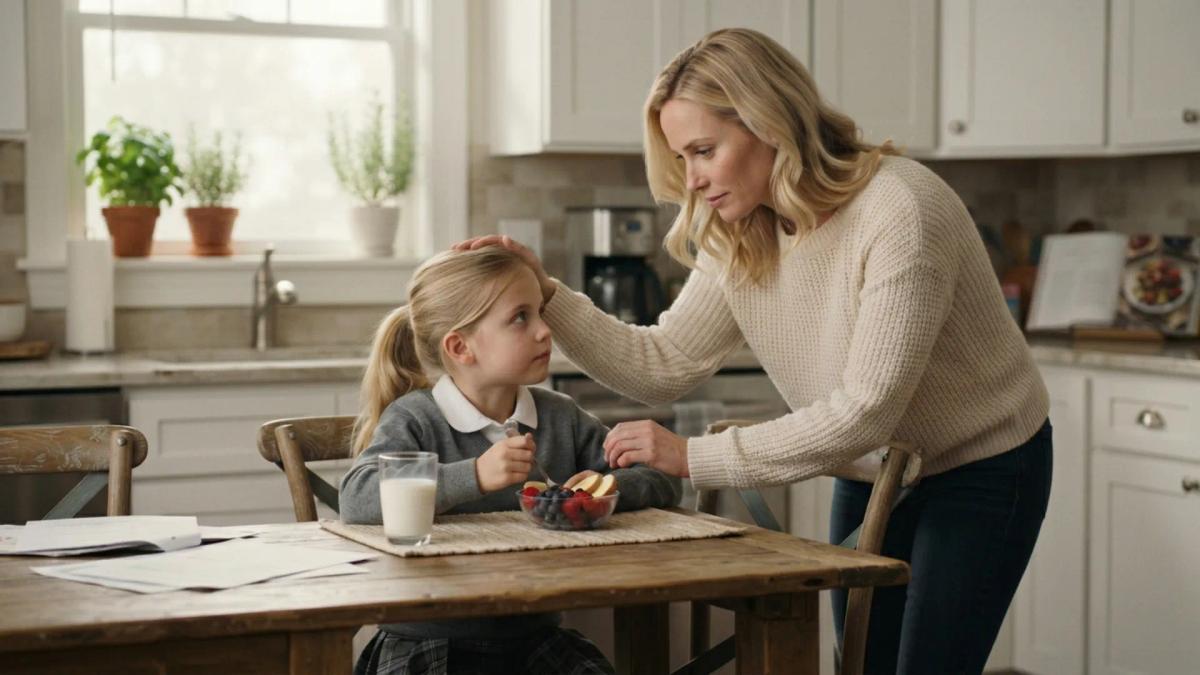
The natural instinct of parents who want to help is to ask. How was it? Did you make friends? Did you like the teacher? What happened at recess?
The problem isn’t the question. It’s the volume and the timing. A child who has just come out of an intense day of social containment is rarely ready for an interview at the school gate.
A few ways to stay connected without pushing:
Let the snack go first. A few minutes of physical decompression and food before any questions. The brain that just left school mode needs a pause before it can narrate what it lived through.
Swap open questions for observations. “You look tired today” opens more than “How was your day?” It doesn’t demand a response or apply pressure, but it shows you’re paying attention.
Create a transition ritual. A specific snack, a song in the car, fifteen minutes of screen time with no mandatory conversation. Decompression rituals signal to the nervous system that the hard part of the day is over.
Normalize what she’s feeling, even without her saying it. “I know starting somewhere new is tiring even when it’s going well.” She doesn’t need to confirm it to feel seen.
Keep the rest of life stable. Schedules, meals, bedtime rituals, weekends. When one part of life changes a lot, stability in the other parts gives the adjustment room to happen.
(You don’t need to fix the adjustment. You just need to be steady while it happens. Those are different things, and luckily, the second one doesn’t require you to know the name of a single kid in her class.)
When the school is new, but the child is older.
Older children and pre-teens who change schools face an extra layer: their social awareness is developed enough that they know exactly what they’re losing and what they’re risking.
They know the groups have already formed. The dynamics already exist. Joining mid-game is more complicated than joining at the start.
And they feel the pressure of not appearing desperate for friendship, which makes everything lonelier than it needs to be.
With them, the approach shifts; ask fewer questions about friends (which can make them anxious), and give more space to talk about what’s hard without turning it into a problem to fix. And be patient with the “I don’t have anyone yet” phase; it lasts longer than you’d hope, but it does pass.
(For a pre-teen, not having friends yet can feel really tough. Don’t minimize it or try to speed it up. Just be there with them.)
In the end
Changing schools is one of childhood’s most underestimated transitions—not just because it’s a big event, but because it’s full of invisible challenges: learning a new social code, building trust from scratch, finding your place in a space that doesn’t feel like yours yet.
The child who looks fine on the outside may be working enormously hard on the inside. And what she needs most in these months isn’t solutions.
What matters most is having an adult who keeps showing up, doesn’t push, and trusts the process even when it’s a little bumpy.
(One day, she’ll look back and that new school will just be the school. But right now she’s still figuring out how to get there. And she doesn’t have to get there alone.)
FAQs
How long does it take for a child to adjust to a new school?
Most research on school adjustment points to an average of three to six months for full social adjustment — not the routine, which comes earlier, but the feeling of belonging. This varies a lot by temperament, by how welcoming the school is, and by how many connections the child manages to form. There’s no right number. There’s each child’s own timeline.
She cries every morning before going. What do I do?
Validate without reinforcing avoidance. “I know it’s hard. You can do this.” That’s different from “It’s nothing” (which invalidates) and from “We’ll skip today” (which teaches that crying gets her out of school). If the crying persists for more than three or four weeks, or comes with frequent physical symptoms, a conversation with your pediatrician or a psychologist can help assess whether there’s more significant separation anxiety at play.
She says she has no friends. How do I help without forcing it?
First, validate: “I know you haven’t found your people yet. That takes time, and it’s hard.” Second, create low-pressure opportunities, a classmate over to the house, an extracurricular activity where she can build connections outside of classroom dynamics. Third, avoid comparing to how things were at her old school: that kind of mention, even well-intentioned, deepens the sense of loss.
Should I talk to the school about how she’s feeling?
Yes, especially in the first few weeks. Teachers and school counselors who know a child is in transition can pay closer attention to how she’s integrating, facilitate inclusion, and notice signs you don’t see at home. The partnership with the school is one of the most underused tools in this period.