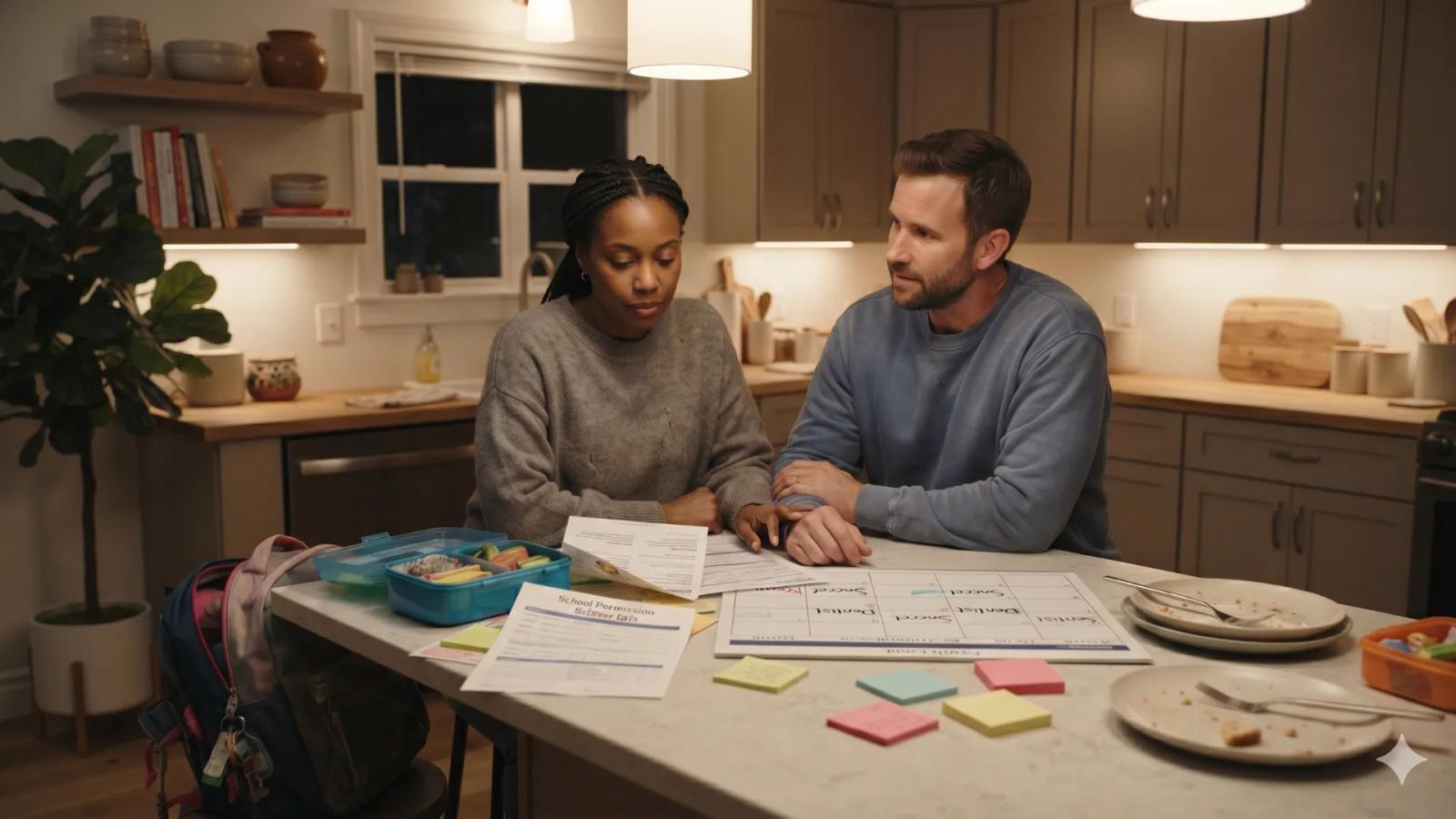
At some point, often without a clear before-and-after moment, you look at the person you chose and realize that most of what you say to each other is about logistics.
Who’s picking up, who’s making dinner, whether the permission slip was signed, what time the appointment is, whose turn it is to handle whatever needs to be handled tonight. You’re a highly efficient operational unit. You co-parent well. You function.
And somewhere beneath the functioning, something that used to be more visible has gone quiet. Not gone, but quieter. The couple you were before the children arrived is still in there, somewhere, underneath the schedule and the exhaustion and the particular intimacy of two people who have been through a lot together and stopped talking about most of it.
This is one of the most universal and least discussed experiences of parenting. Not because it’s shameful, but because it’s so normal it barely seems worth naming, and because naming it feels like admitting something is wrong when mostly what’s happened is that life got very full and the relationship adapted to fit.
The adaptation is understandable. The question is whether it’s permanent or whether there are small things that can shift it without requiring a weekend away, a dramatic conversation, or anything that exceeds the current capacity of two exhausted people.
There are. That’s what this is about.
What actually changes when children arrive

The shift in a relationship after children isn’t usually a single dramatic change. It’s a series of small structural changes that add up to something that feels like a different relationship, without any clear decision having been made.
Time disappears, and with it spontaneity. The unstructured hours that relationships live in, the lingering over coffee, the conversations that go nowhere useful, the doing nothing in particular together, become scarce in a way that’s hard to overstate. What remains tends to be scheduled or purposeful, and scheduled purposeful time is a different quality of time than the unstructured kind.
The mental load is distributed unevenly and creates resentment. Even in relationships with genuine intentions toward equity, the cognitive and logistical load of parenting tends to fall more on one person than the other. The person carrying more starts to resent it, often without articulating it clearly. The person carrying less is often genuinely unaware of the imbalance. Resentment and unawareness are a bad combination and one of the most reliable sources of distance.
You become co-workers before you become partners. The shift from couple to parenting team is mostly necessary and mostly good, but it comes at a cost: you start to relate to each other primarily in your functional roles, and the non-functional version of each other, the person who existed before and underneath the parent, gets less airtime. Over time, the person you knew and the person who handles the logistics start to feel like different people.
Physical intimacy changes, sometimes dramatically. Exhaustion, touched-out-ness, the loss of privacy, the shift in how bodies feel and are experienced, the particular challenge of desire in a context where someone is always needing something from you: all of these affect physical intimacy in ways that are real and rarely talked about honestly, because the conversation feels too fraught or too vulnerable to start.
Conflict styles collide around parenting decisions. Two people who navigated their differences reasonably well before children often discover that parenting surfaces new disagreements, about discipline, about risk, about how much freedom to give and when, about values that seemed aligned until they were tested by actual small humans. These disagreements can feel like discovering something wrong with the relationship, when they’re often just the relationship being used in a higher-stakes context than before.
None of these changes means something is wrong with your relationship. They mean you had children, which is an enormous structural change to any system, and the system adapted. The question is whether the adaptation is serving you or whether it’s become the whole story.
The particular problem of not having the conversation
One of the things that makes the drift harder to address is that it rarely announces itself. There’s no moment when one person turns to the other and says, "We’ve become roommates who share a parenting project, and I miss the relationship we had." Instead, there’s just a gradual accumulation of not-quite-rightness, a low-grade background hum of something that’s off, that both people feel and neither person names because naming it requires having a conversation that seems too large or too vulnerable or too likely to become a fight.
The not-naming keeps the distance in place. Things that are named can be addressed, even imperfectly. Things that aren’t named just continue.
The conversation doesn’t have to be large. It doesn’t have to be a reckoning. It can be as small as: “I miss us. Not in a crisis way. Just in a… I notice we’ve mostly been about the kids lately and I’d like to be about us sometimes too.” That’s a starting point, not a conclusion.
A conversation that starts small and is received well is almost always better than one that’s been held too long and arrives under pressure. Small and early beats large and late, almost every time.
What reconnection actually looks like during the parenting years

Reconnection in this phase of life doesn’t look like it did before children. The long weekends away, the spontaneous evenings, the unhurried getting-to-know-you-again that romanticized notions of relationship maintenance tend to require: these are available sometimes and unavailable most of the time. Waiting for them to be available is a way of postponing reconnection indefinitely.
What actually moves the needle tends to be smaller, more frequent, and considerably more ordinary:
Ten minutes of conversation that isn’t about the children or the schedule
This sounds easy and turns out to be genuinely hard because the children and the schedule are where most of the shared material lives. But there are other materials: what you’ve been thinking about, something you read or heard that stayed with you, something you’re looking forward to, something that’s been on your mind that has nothing to do with logistics. Ten minutes of that, a few times a week, maintains the sense of knowing each other as people rather than as co-managers.
A moment of physical contact that isn’t leading anywhere
Not sex, not necessarily, though that matters too. Just touch that exists for its own sake: a hand on a shoulder, sitting close enough to be in contact, a moment of physical acknowledgment that says I know you’re there. The absence of this kind of low-stakes physical connection is one of the first things to go when things get hard and one of the most quietly significant losses.
Noticing something specific and saying it
“I noticed how you handled that with the kids tonight.” “That was a hard week, and you held it together.” “I’m glad you’re the person I’m doing this with.” These aren’t grand gestures. They’re small acknowledgments that the other person is seen, which is one of the most fundamental things a relationship provides and one of the first things to thin out when both people are running at capacity.
Handling the equity conversation before it becomes a resentment conversation
If the load is distributed unevenly, naming it and addressing it is relationship maintenance, not conflict. A regular, calm conversation about who is carrying what, what feels manageable and what doesn’t, what could be redistributed, is far less corrosive than the alternative: resentment that builds until it needs an outlet, which is almost never a productive one.
Protecting one ritual, however small
A show you watch together after the kids are in bed. Coffee before the house wakes up. A walk on Sunday morning. The specific content matters less than the consistency: one recurring thing that belongs to the two of you, that isn’t about parenting, that happens reliably enough to become something you both count on. The ritual says: there is an us here, separate from the parenting, and it’s worth protecting.
Talking about something other than problems
Relationship conversations during the parenting years tend to be about what’s hard, what needs fixing, what went wrong, what needs to be decided. This is necessary and also, if it’s most of what you talk about, slowly corrosive. Deliberately introducing conversations about what’s good, what you’re looking forward to, what you’re curious about, what made you laugh: it’s a small thing, and it changes the texture of the relationship significantly.
None of these require scheduling, babysitters, or perfect circumstances. You just have to decide to do them, consistently enough that they become a habit. The habit is what matters. Habits are what the relationship is made of.
On the question of whether this is fixable
Most of what happens to relationships when children arrive is not a problem to be fixed. It’s a transition to be navigated. The relationship didn’t break. It changed under significant pressure and adapted, and some of what it became is less than what you’d choose if you were designing it from scratch.
The things worth addressing are the ones that have become structural: persistent resentment that isn’t being spoken, significant inequity in load that isn’t being acknowledged, a level of distance that has started to feel more like the relationship than like a phase of it. These are worth naming and working on, sometimes with professional support, which is a resource more couples should reach for earlier than they do.
The things that don’t need fixing are the ones that are just the phase: the exhaustion, the reduced spontaneity, the fact that you know each other’s sleep schedules better than you know each other’s current desires. These pass, or at least they change, as the children grow and the intensity of the caregiving phase gradually shifts. What you want is for the relationship to still be there, recognizably, when that happens.
The goal during the hard years isn’t to have a great relationship. It’s to have a relationship that survives the hard years intact enough to become great again on the other side. That’s a different and more achievable standard.
In the end
The couple you were before children is still there. It’s just quieter, more tired, and operating in less of the available space than it used to. It hasn’t disappeared. It’s waiting for slightly more room.
You don’t have to create a lot of room. Ten minutes of conversation that isn’t about logistics, a moment of physical presence, something noticed and said out loud: these are small things, and they add up to the maintenance of something worth maintaining.
You chose each other before the children. The children are one of the best things you did together. And the relationship that made them is worth tending, not in dramatic ways, but in the small, repeated ways that relationships are actually made of.
You’re not just parenting together. You’re also still two people. That second part is easy to forget and worth remembering.
FAQs
We barely fight. Does that mean we’re okay?
Not fighting isn’t the same as being connected. A lot of couples with kids slip into a sort of low-conflict, parallel routine. Things work, more or less, but there’s a distance. Just because you’re not fighting doesn’t mean the relationship is thriving. Sometimes it only means you’ve both learned to get by with limited friction. It’s not nothing, but it’s not the same as being well together. Checking in on your connection, not just whether you’re arguing, gives a much clearer picture.
My partner doesn’t think there’s a problem. How do I start this conversation?
Starting from what you miss rather than what’s wrong tends to produce a different response. “I’ve been missing us lately, and I’d like to find some small ways to spend more time together that’s just ours” is a different opening than “I feel like we’ve drifted and I’m worried about us.” The first is an invitation. The second is an alarm, and alarms produce defensiveness. Start with the invitation.
Is it normal to feel like roommates?
Very. The roommate feeling is one of the most commonly described experiences of the parenting years, and it’s a fairly accurate description of what happens when two people’s shared life becomes primarily organized around a third party’s needs. It’s worth naming when it’s happening and worth taking small steps to introduce a non-logistical connection, but it’s not a verdict on the relationship or an indicator that something irreversible has happened.
When should we consider couples therapy?
Earlier than most people do. Couples therapy is most effective as a tune-up, not an emergency intervention, and most couples who eventually seek it report wishing they’d gone sooner, before patterns had solidified and resentment had accumulated. If you’re finding that the same conversations circle without resolution, that the distance feels persistent rather than situational, or that one or both of you feel consistently unseen or unheard, those are useful signals. Going while things are manageable is a sign of taking the relationship seriously, not of it being in crisis.