When our daughter was about one and a half years old, bedtime was… hard. Very hard.
Toddlers crave predictability. The world does not yet make sense, and adult lives are exactly what toddlers find hard to process: unpredictable and varied.
This taxes them mentally.
What can you expect from this? Chaos.
Especially at the end of the day. God help you at bedtime.
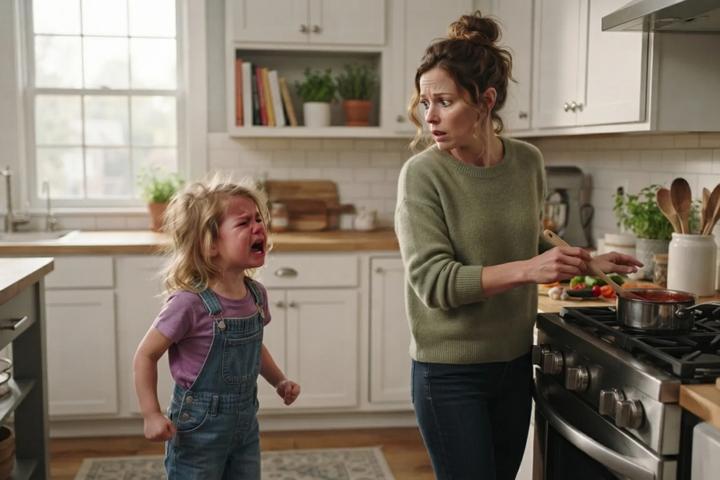
Let’s paint a familiar scene: with our toddler safely snuggled under her blanket, we would leave the room… Only to be drawn in by a full meltdown as soon as the door closed. We would calm her down, and try to leave. Again. And again...
Every evening turned into a long negotiation that none of us really wanted to be in.
One night, asleep on our feet, we did something slightly ridiculous.
We invented a song.
The lyrics were not exactly award-winning:
“And now the door is going to be closed,and now the door is going to be closed,and now the door is going to be closed,and papa and mama are leaving.And papa and mama are leaving,and the door is going to be closed.Good night.”
Then we closed the door.
And—unexpectedly—it worked like a charm. There was no protest.
It wasn’t a guaranteed fix, but it worked nine times out of ten.
That silly little song became a cherished ritual.
And that ritual changed our evenings.
Why transitions are so hard for toddlers
What I didn’t understand at the time—but see clearly now—is that toddlers don’t struggle with what is happening. They struggle with the moment of change itself.
Transitions are hard because they are uncertain.
For a young child:
- One state suddenly ends (play, connection, presence).
- Another begins (sleep, separation, stillness).
- And they don’t yet have a clear sense of exactly how to move to the next stage.
That gap— between now and what’s coming— is where anxiety lives.
When we simply said, “Good night, time to sleep,” the ending felt abrupt.
Sudden.
Final.
But the song did something subtle and powerful.
What rituals actually do
The song wasn’t magic. It didn’t make her more obedient, nor convinced her with logic.
What it did was make the transition predictable.
The same words.The same order.The same ending.
It created a countdown. She knew exactly what would happen, and when.
Instead of a sudden separation, bedtime became a known sequence: First the song > then the door > then sleep.
Nothing surprising was about to happen.
And when uncertainty dropped, her nervous system relaxed.
With predictability came calm.
This isn’t about bedtime
The reason this works isn’t specific to sleep.
Toddlers struggle with transitions everywhere:
- Leaving the playground;
- Turning off the TV;
- Getting dressed;
- Saying goodbye;
- Switching activities…
… In all those moments, the problem is rarely “defiance.”
It’s the transition that overwhelms them.
Give them a predictable ritual that takes them through that transition.
How to use this in your own family
If you’re stuck in a daily negotiation loop, try this:
Create a small, repeatable ritual that marks the end of something.
It can be:
- A song
- A phrase
- A short sequence of actions
- A predictable countdown
It doesn’t need to be creative or beautiful. God knows our song wasn’t.
It needs to be the same every time.
Rituals give children something solid to lean on when change feels big. They turn endings into something understandable instead of unnerving.
Sometimes, a silly little song really is all you need to get some sleep.